
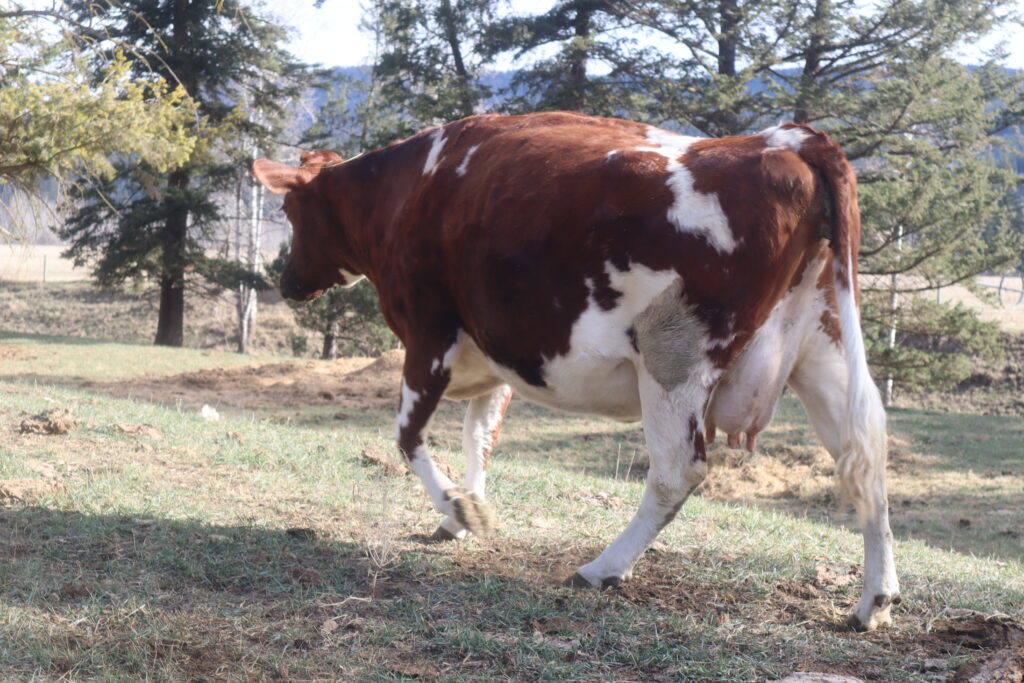
June is a busy month for me, I am giving 4 different presentations at two different conferences. One in Tennessee and one in Idaho. One of the presentations I am giving is on supporting your cow through her lactation and I thought focusing on diet throughout a cows lactation would be a great blog post for the Milkmaid Society this month.
Milk cows will have different dietary requirements throughout their lactation. In todays blog post I have broken up the stages of your cows lactation into 5 stages;
- 2 weeks pre calving
- Freshened cow and up to peak lactation
- After peak lactation
- Preparing for dry up
- Dry phase
Before we jump into this blog post here are a few rules of thumbs about how much a milk cow can be expected to consume.
- 30-40lbs of dry feed per day
- 30 gallons of water per day
- 3lbs of grain per gallon of milk produced
- Always given access to free choice (meaning they get to control how much they eat) loose minerals, salt and baking soda
2 weeks pre calving
In the two weeks before a cow calves their body condition should be between 3-3.5 on the body condition score scale. Cows diets will naturally decrease in the few weeks before calving so it’s important for them to be in good condition going into this pivotal time. These two weeks before calving are crucial in setting your cow up for success throughout her lactation. Cows that go into calving under or over conditioned are highly susceptible to metobolic problems such as ketosis or milk fever, as well as calving difficulties.
Feed Requirements for a cow 2 weeks pre calving
- Cows have a decrease in appetite in the few weeks before calving, which means you really want them to be in ideal condition prior to this.
- Begin a transition diet (also known as lead feeding). In the weeks leading up to calving begin adding grain into your cows diet. The goal is to slowly increase the grain so that when your cow calves she can immediately start on her full ration. The rule of thumb for grain is 1lb of grain for every 3lbs of milk or to make the math easier, about 3lbs of grain for every gallon of milk produced. An example would be a cow that produces 5 gallons of milk a day will need about 15lbs of grain. Calculate how much you expect your cow to produce at freshening and start with a small amount of grain working up to your cows full ration.
- Limit fresh grass and alfalfa with cows 2 weeks pre calving. Keeping dry cows off of green grass/alfalfa for 2 weeks before calving helps prevent milk fever because it prepares their metabolism for needing to mobilize calcium from their bones. In cows fed high calcium diets prior to calving, their bodies are working to try to lower calcium.
- Access to loose minerals and salt. Minerals are everything with cows! Cows fed a diet and supplements that are supporting their mineral needs will have far less health problems, calving difficulties and better lactations. You know that your cow is supported if her eyes are bright, her coat is shiny, she is in good condition.
- 4oz/120 mls of apple cider vinegar a day, 2 weeks prior to calving to prevent milk fever because of the acidity, it stimulates the bones to release small amounts of calcium into the blood. This apple cider vinegar can be added to grain rations or into the water trough.
- Typically we are feeding dry cows what we call dry cow feed. On our ranch this is first crop hay. First crop hay tends to be courser due to thicker stems as well as seed heads or flowers. It is higher in fibre, but contains less protein then subsequent crops. Its still good feed but it is less in quality than our second crop cuts. We feed dry cows first crop hay with the intention of maintaining their condition but keeping them from becoming over conditioned.
- Unlimited access to clean fresh water.
- Free choice baking soda. It is always a good idea to keep baking soda out free choice for milk cows to help themselves to as needed. Baking soda acts as a rumen buffer if for whatever reason the rumen has become too acidic.
Freshened cow and up to peak lactation
A freshened milk cow is at risk for many different health complications. Supporting their diet and making sure their needs are met is one of the best ways to prevent illness in your milk cow and set them up for a good lactation. Cows typically reach peak lactation at about 60-90 days in milk, during this time their milk production will continue to increase and their body condition will decrease. Their body condition should be maintained between about 2.25 to 2.75 during this time.
Feed Requirements for a freshened cow up to peak lactation
- Prioritize palatable feed! You could have the best, most expensive feed but if your cows not eating it, it’s not going to support them. Freshened cows tend to have decreased appetites so, it is very important that you support them with palatable food that is very good quality. We shift from dry cow feed (1st crop hay) to lactating cow feed (2nd crop alfalfa/grass hay). This feed is softer and higher in protein than dry cow feed. The cows typically eat it up like candy.
- If you do not have access to high protein feed, you can support your cow with supplementation of alfalfa pellets or grain supplements.
- Most cows, unless specifically bred with grass fed genetics in mind, will need supplementation with a grain ration. If you completed a transition diet, your cow can be started on her full ration, but if you did not use a transition diet you will want to slowly increase their ration by about 5lbs of grain every few days until you reach the desired amount. The rule of thumb for grain is 1lb of grain for every 3lbs of milk or to make the math easier, about 3lbs of grain for every gallon of milk produced. An example would be a cow that produces 5 gallons of milk a day will need about 15lbs of grain. There is a lot of opinions on the best grain mix to feed your cows. The best one is the one that helps your cow maintain her body condition within her lactation range. The mixture that I have personally used before is 16% dairy ration mixed 50:50 with barley. Depending on where you live, you will have access to different grains and mixes.
- If you need to entice them to eat, you can use molasses mixed in with their grain or even water. The key is to keep them eating.
- Many people feed their milk cows molasses water immediately after calving to give them a boost of energy, as well as perhaps prevent ketosis (no research to back this). This sugary water gives your cows a much needed surge of energy. To mix up molasses water mix 1 cup of molasses in 5 gallons of water. If they drink all of this, you can repeat.
- Calcium oral bolus post calving. Many people choose to feed their cows a calcium bolus immediately after calving to prevent milk fever.
- Access to loose minerals and salt. Minerals are everything with cows! Cows fed a diet and supplements that are supporting their mineral needs will have far less health problems, breed back easier and have better lactations. You know that your cow is supported if her eyes are bright, her coat is shiny, she is in good condition and she breeds back in a timely manner. Typically you will breed your cow back at about 45-60 days post calving. A cow that is repeatedly not catching, should have their minerals adjusted to meet their needs better.
- Unlimited access to clean fresh water.
- Free choice baking soda. It is always a good idea to keep baking soda out free choice for milk cows to help themselves to as needed. Baking soda acts as a rumen buffer if for whatever reason the rumen has become too acidic.
After peak lactation
Once your cow has gone past peak lactation she will begin to reduce her production slightly, by how much is very cow dependant. Some cows will begin to dry themselves up, others will continue to produce a large amount of milk right until dry up. Typically cows body condition increases during this stage and if your cow is lowering her production drastically, it is important to keep them from becoming over conditioned. Body condition usually ranges from 2.75-3.25.
Feed requirements for a lactating cow after peak lactation
- lactating cow feed (high protein feed that maintains their condition as well as production). This can be in the form of pastures or hay.
- Grain or dietary supplements to support their production as well as body condition
- Access to loose minerals and salt
- Free choice baking soda
- Unlimited access to clean fresh water
Leading up to dry up
About a month before you plan to dry your cow up, you will want to start preparing her for the dry up process by decreasing her production. This is commonly done by decreasing milking from twice a day to once a day, and stopping or reducing grain. It is important that cows go into the dry period in a good body condition. Cows that are under conditioned can be given a longer dry period of 4 months, whereas cows that are properly conditioned or over conditioned should not be given more than 2 months of a dry period before calving.
Feed requirements for a cow leading up to dry up
- Support an optimal body condition with feed. You may choose to switch to dry cow feed (lower protein) to reduce milk production as well as maintain her body condition in an optimal range.
- Stop or reduce grain with the intention of lowering milk production to 2 gallons a day or less at dry off.
- Access to loose minerals and salt.
- Free choice baking soda.
- Unlimited access to clean fresh water.
Dry phase
Dry cows need their nutrition supported to aid in the growth of a healthy calf and prepare their bodies for calving. Dry cows tend to be more prone to becoming over conditioned because they are not lactating. Priorities for your dry cow should be providing them with adequate nutrition as well as exercise. One of the best ways to do this is put the water trough on the other side of the pen than the feeder.
Feed requirements for a dry cow (further than 2 weeks pre calving)
- Dry cow feed. An example of dry cow feed for us is 1st crop alfalfa/grass hay. It is courser than second crop hay and tends to be lower in protein and higher in fibre.
- Access to loose minerals and salt
- No grain or very limited grain ration
- Free choice baking soda
- Unlimited access to clean fresh water
One Response