
By Robyn Jackson
I am asked many questions about calf sharing every month. The idea of sharing the work of milking with a calf is very appealing and people practice calf sharing throughout the world!
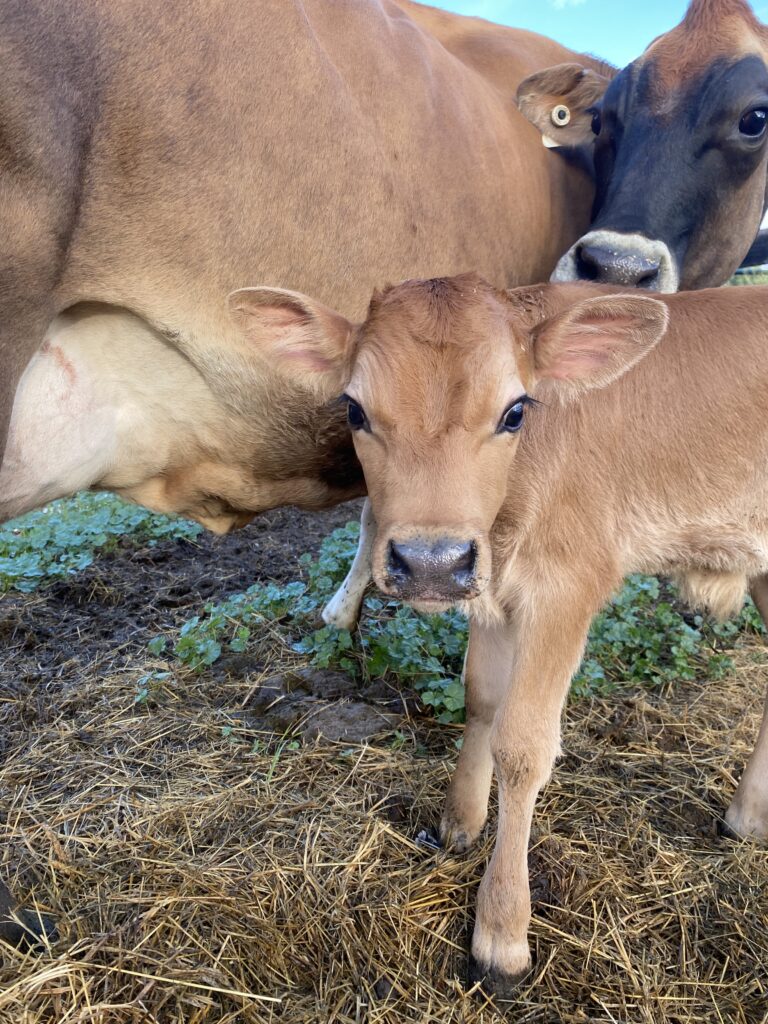
Calf sharing is when instead of removing the calf from the cow and bottle feeding the calf, you leave the calf with the mother and let it drink.
Calf sharing has several benefits including;
- Less work to care for the calf
- The calf will grow bigger and healthier when given the opportunity of free range milk verses a bottle.
- You always have someone around to help you milk. A built in relief milker!
- The cow and the calf get to stay together. Personally I love watching the bond that forms between a cow and her calf. It makes me so happy to know that a calf gets a mother rather than a bottle.
Though Calf sharing has benefits, it also has negatives;
- Cows will hold back cream for their calves. This is true! The hind milk, meaning the milk that comes last, is the richest in cream. If a cow knows that she will be feeding a calf soon, she will hold that hind milk back for the calf. You may not even know she is holding back initially, but when she leaves the milking stall and sees that calf, all of a sudden her udder looks full again. Typically I see my cream line decrease in inches when I am calf sharing. Though it depends on the cow, some of them are just better at it than others, I will typically see a one inch cream line in a gallon jar when I am calf sharing and a 3-4 inch cream line when I am not.
- It can create problems in the milking stall. A cow that forms an attached bond to a calf, may never relax fully in the milking stall. This usually dissipates as the months go on, but for the initial month after calving (an adjustment time), you may encounter several problems like difficult let down, dancing around, calling out, just general bad behaviour. It is not the end of the world, and there are several tips and tricks to help with this that we will discuss further on.
- As the calf gets bigger they will take more and more of the milk. Eventually you will have to start separating the calf for a certain time frame to get any milk at all.
- The calf can sometimes damage the teats. Again, more about that later and ways to stop it.
So now that you have seen a few of the pros and cons of calf sharing, let’s dive into how to actually calf share and a few more details on the finer points.
First off though, Will My Dairy Cow Take Her Calf?
On our ranch, our whole philosophy of raising dairy cattle revolves around calf sharing. In 2014 when we acquired our first dairy cow, her primary purpose was to act as a nanny cow for our beef herd. Her name was Fanny and she was the first of many nanny cows that would feed beef calves who didn’t have a mother. We still use nanny cows on our ranch and it is not uncommon to have 2-3 calves on each dairy cow. Keeping nanny cows has given us a unique viewpoint on dairy cows as mothers. Other than the family milk cow, it is pretty rare that dairy cows will have the opportunity to be mothers, most large dairy farms remove the calves after they have drank colostrum for a few days. If you are worried that the mother “instinct” has been bred out of dairy cows, do not worry! It is not!
The bulk of our nanny cows are Holstein cull cows off of a local dairy. These cows come to us often older, and having never raised calves. Out of the 7-8 nanny cows that we have had, only one of them ever refused to take calves. In fact even though she wouldn’t take graft on calves, when she had her own calf a year or so later, she took it with no problems. All of the others, didn’t think twice about allowing a calf to feed, and caring for that calf in the process.
Dairy cows often want to be mothers, and are good at it. Just like in the beef cow world, there are sometimes instances where this is not true, but for the most case, you don’t have to worry about them not taking their calf. With heifers (first time calvers that is) you often have to help them along and show them the ropes for the first few days, but once they get the hang of it, they will care for that calf well.
What If I Want To Graft On Calves?
If you have an orphan calf, or just want more of the milk to be taken care of, you may consider grafting another calf onto your cow. This is totally possible and like I said above, we do this often.
To do this we have a few methods that we work through to get the cow to take the calf. It depends a lot on the cow and the calf as to how long the process will take, and what methods you need to use.
Method 1– Put the cow and calf in a small pen together with limited space. If the calf already knows how to drink from an udder, it should be persistent enough to make the confined quarters work for it. After a few days in confinement, the cow has often bonded with the calf.
Method 2– If the calf does not know how to drink yet, or if the mother is persistent in not allowing it to drink, we will move to putting the cow into a chute or head gate a few times a day to allow the calf a chance to drink. Usually after a week or so of doing this, the cow will accept the calf.
Method 3– If we have a calf die after it has already had a chance to bond with its mother and we would like to put another calf on that cow, we will often skin the dead calf and tie the hide to the new calf. This seems barbaric but it actually works really well. In a confined space, the cow will often accept the calf much quicker because it smells like her old calf.
How to Calf Share
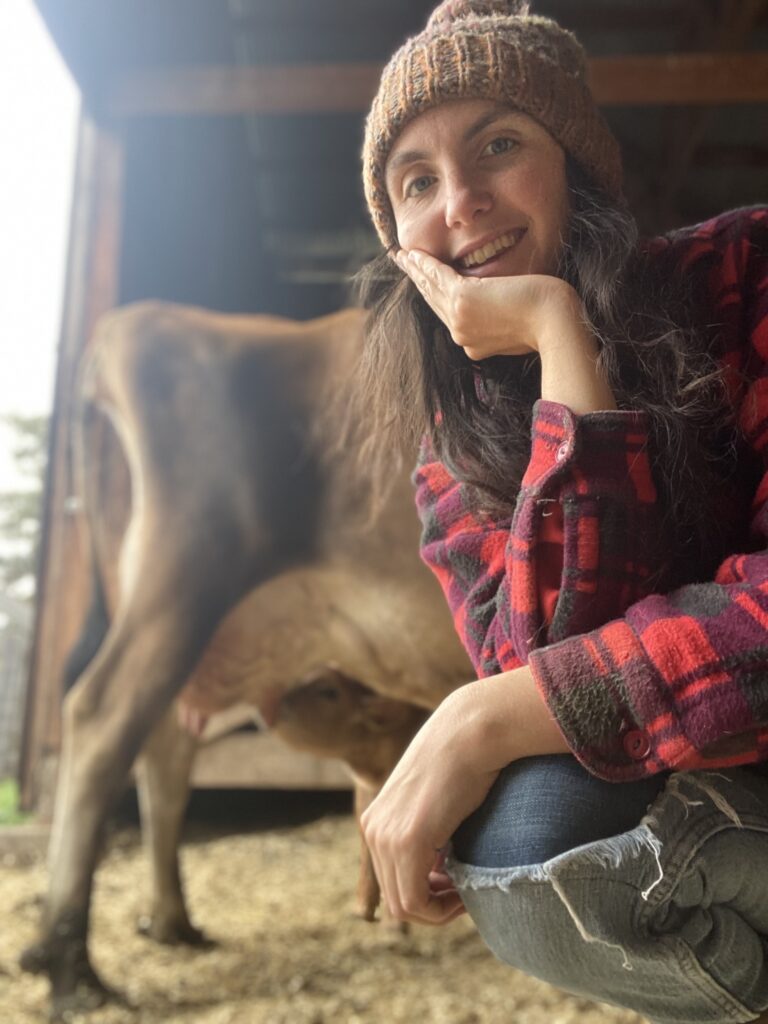
Now that you have a calf on your cow, whether it is naturally born, or grafted, it is time to think about calf sharing and how that will work for you as the milkmaid wanting to share the milk and the chore of milking.
Again this depends heavily on the cow, the calf and the production level. Today I am going to be talking about calf sharing with high production cows. If you have a lower production cow, you may need to skip to the separating step earlier.
Timeline
Calf is just born
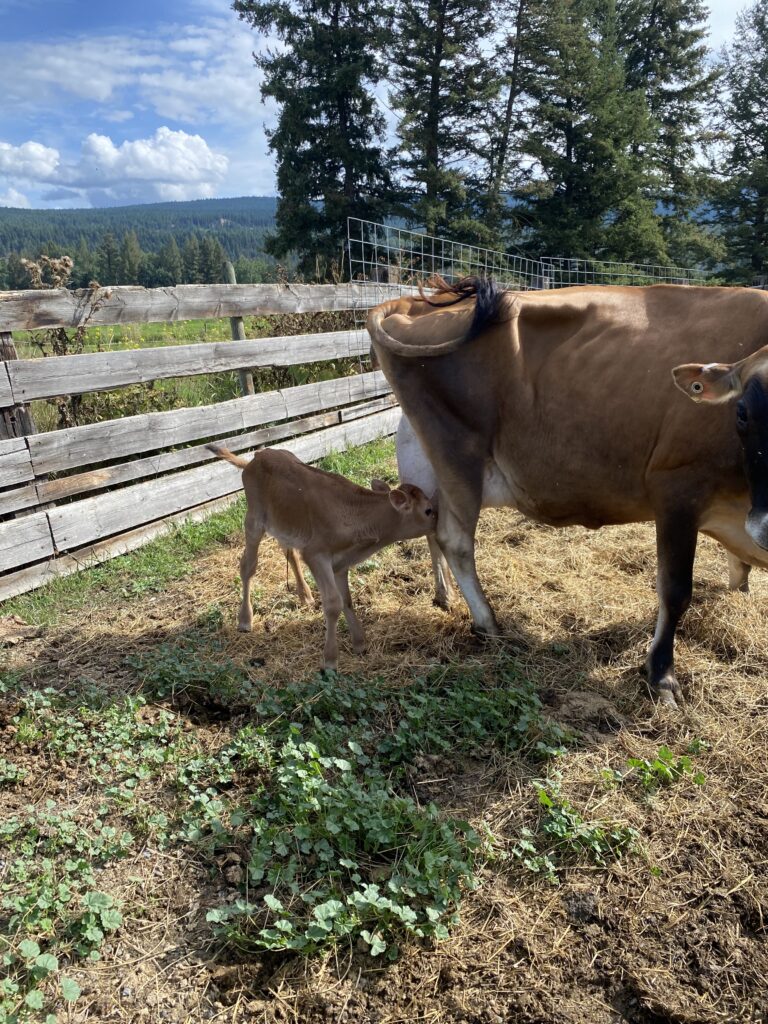
Initially after the calf is born the cow will produce colostrum for the at least the first 48 hours before you start seeing milk come in. During this time, it is important to let the calf drink freely and to make sure the calf is actually drinking. We usually milk our cow about 12 hours after she gives birth. At this point you do not have to be worried about emptying her completely. What with edema, it would be impossible to do so anyway. The only reason we milk during this time, is to help relieve pressure, and to acquire some of the colostrum.
Colostrum is a valuable substance on a ranch. We freeze it and keep it for other calves that need it during calving season. As colostrum is a rapidly changing product, we always label the freezer bags with first milking, second milking, third milking. So that we can decipher which colostrum is the highest in nutrients later on.
Many people choose not to milk during this time. In fact it is not uncommon for people to not milk their cow for the first 48 hours after giving birth.
Once the milk comes in
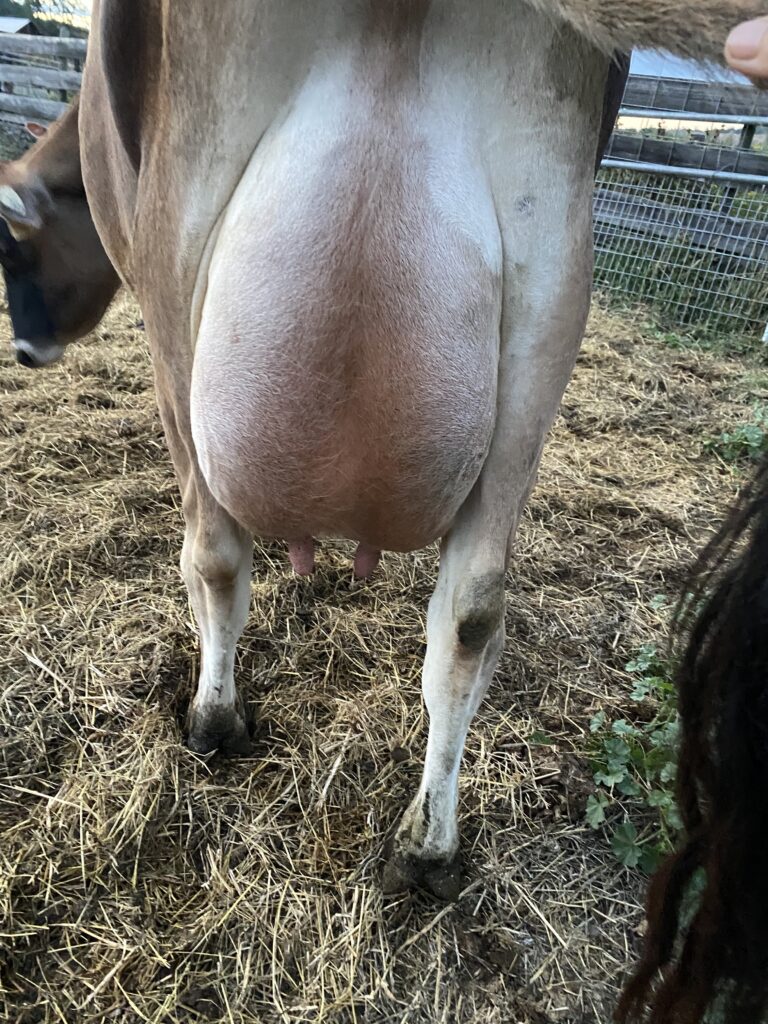
A few days after giving birth, your cows milk will start to come in. For up to a week after birth, it will still contain some colostrum and for this reason, I don’t use it for making cheese during this time. (Colostrum does not coagulate properly, plus this first milk often contains tissue shedding and can be a higher somatic cell count).
After 48 hours, or when the milk comes in, I always start twice a day milking. At this point with a high production dairy cow, they will have a lot of milk. More milk than a few day old calf can handle on their own. It will take weeks, if not a few months, before the calf is large enough to handle all of the milk. Consider that a high production dairy cow reaches peek lactation around 6 weeks. As the calf grows, so does the milk production and as your cow is still headed towards peek lactation, there is a lot of milk during this time.
For me it usually takes at least 1-2 months before the calf is large enough to handle one of the milking on their own. During this first few months of calf sharing, the calf stays on the mother 24/7 and is only separated while the mother is in the milking stall. Even though the calf is on the mother constantly, she still has a lot of milk for me twice a day. Often times, you will see that the calf prefers one or two of the quarters and you will notice that you don’t get as much milk from these quarters.
During this time, I don’t strip out my cow completely. I milk her almost all the way out, but when it comes to making sure every last drop is gone, I leave that to the calf. Calves are very efficient at emptying udders and they leave you with a bit of an insurance policy that yes the udder will be completely emptied out. If you have been terrified of your cow developing mastitis because you didn’t empty her out completely, calf sharing will set your mind at ease! The cow has most likely held back milk for the calf anyway, and that calf will strip her out well.
Once you are not getting any milk
There will come a point when you have to start separating the calf from the cow to get any milk. This is your natural indication that the calf has grown large enough to handle one of the milking’s. Depending on the cow and calf this will happen a few weeks to a few months after birth. If you are calf sharing because you want a relief milker, you have reached your destination. The calf is large enough to handle a milking while you go away.
If you want milk though, you will need to start locking the calf up for 6-12 hours before milking. For us, we usually make this easy by locking the calves in an adjoining pen at night. Before bed we go down and lock up the calf, then in the morning we take however much milk we want, before reuniting the cow and calf for the day.
For me, it is important if I am going to be reuniting the cow and calf directly after milking, that I leave some milk back for the calf. If you strip your cow out completely, you will want to leave the cow and calf separated for a few hours so that she can refill. A hungry calf that has been locked up all night will be ravenous and can damage the teats. Some calves are more prone to this than others. One time we even had to float a calfs teeth because he had sharp points on them. The fact is, when they are hungry they can be aggressive and if they are sucking on empty teats or not getting enough milk when they are hungry, this could cause problems.
How long should you calf share for?
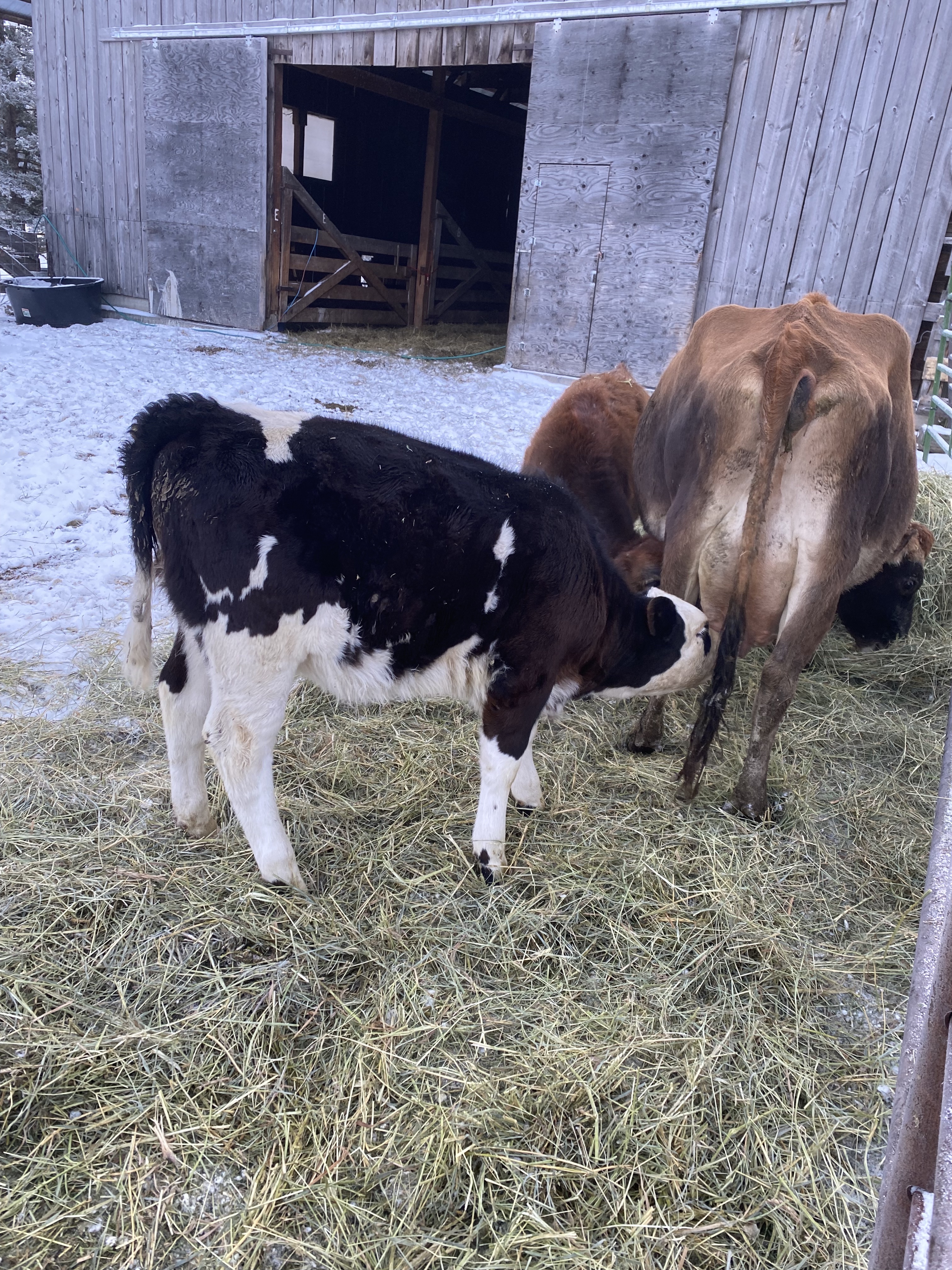
This depends a lot on your homestead, what your goals are for the calf and breeding timelines. A cow can keep a calf on her for up to a year. You will want to wean her at least a few months before she calves again. Some cows, not all of them, will actually wean their calves themselves. Often times calves can be persistent however and will need to be separated from their mother to be weaned. If you are planning on keeping the calf around for awhile keep in mind that even after months of being separated, a calf may still drink from its mother after being reunited. Usually after a few years, they loose this bad habit, but not always. We have had cows drink from cows. It is a problem that only a fence can fix.
If separating the calf from its mother is impossible, you can consider a nose weaner. These are devices that go into the calfs nose and when the calf try’s to drink, the nose weaner pokes the cow and keeps the cow from letting them drink. Calves can be clever though, and they can figure out how to flip the nose weaner up and drink around it.
If you are planning on keeping your calf as a heifer, or as a beef calf, the longer it can stay on its mother the better. 8 months to a year is about the maximum that a calf should be staying on its mother, but this time frame will give you a large healthy calf, albeit in those last months you can say goodbye to your milk supply. Unless separated the calf will drink it all!
We usually wean our calves around 6 months of age, this results in a large calf and at this point they can be getting harder to deal with in terms of locking up and separating.
Conclusion
I never say that we will for sure calf share or that we for sure won’t. The situation changes with each cow and each calf. It is important to be flexible with calf sharing. I sometimes hear from people that are new to owning a cow and excited about calf sharing because it will give them a relief milker. I always caution people from getting their hopes up or banking on it too much. Every cow is different, every lactation is different. What if the calf dies? What if the cow is a aggressive and ornery because she doesn’t want to be separate from her calf? What if the calf cuts the teats? There are too many “what ifs” to get your hopes up. You have to take each birth as a case by case basis and go into every new milking season with the idea in your mind that calf sharing is only one of the possibilities!