
Sharing is caring!
By Morgan Allen
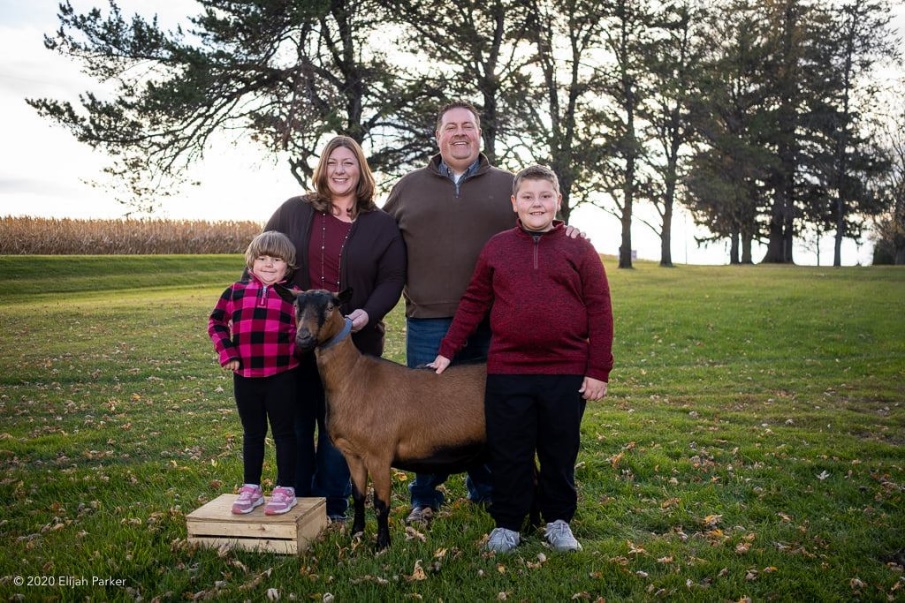
My name is Morgan Allen and I live in Kenyon, MN with my husband, Keith and our two children. We have a herd of registered Oberhasli dairy goats on a small five acre farm. I grew up with goats, having them as pets and for milk mainly, but as my brother and I got older and more involved in 4-H, we began raising and showing the goats as a project. We eventually started genetically improving our herd with registered stock and began showing regionally and nationally. About 12 years ago we also began selling milk to an artisan cheese maker, so had a licensed dairy for that time. We currently keep around 25 milking does and similar number of youngstock and bucks. The herd is mostly Oberhasli, but we do have some Alpine and Oberhalsi / Alpine cross does. We love dairy goats for their calm and gentle nature and quirky personalities. They are a great fit for raising children and teaching about responsibility and work ethic in a safe environment. Goats are also a good fit for small acreage and they adapt well to many housing styles. We enjoy using the milk for drinking, to make confectionary products and for cheese!
In my professional life, I worked as a Ruminant Nutritionist for Big Gain, Inc. for 19 years consulting on both dairy and dairy goat farms in Minnesota, Iowa and Wisconsin. I recently made a career change and am now working for Milk Specialties Global as a Nutrition and Formulations Specialist in the R & D, Animal Nutrition division. I work mainly with milk replacer and fat products, but get to help with some research projects like rumen protected methionine and it’s impact on milk protein in goats!
As you probably know, nutrition is a huge topic and my comments are just a scratch on the surface. I think the main thing to know when feeding your herd is that there are lots of ways to have success. The most important thing is; are my goats healthy and productive! If yes, you are probably already doing a lot of things right. Maybe you could save money somewhere or maybe you could better growth on your kids by making a few small changes.
Diet Requirements Of Specific Goats
Colostrum
- Newborn kids should receive colostrum as soon after birth as possible and within 24 hours.
- Colostrum contains antibodies that protect young kids against diseases.
- At birth, kids do not carry any antibodies against environmental organisms because antibodies in the doe’s bloodstream do not cross the placenta
- Colostrum provides the energy needed to stay warm and acts as a laxative to ensure excretion of meconium.
Three keys to feeding colostrum
- Feed as soon as possible
- Best if within 1 hours of birth
- Ability to absorb antibodies is gone after 24 hrs
- Feed at a minimum of 10% of body weight
- 10# kid should get minimum 16oz of colostrum
- Use high quality colostrum
- Older does tend to have higher quality
- High volumes of colostrum are generally lower quality
Colostrum Sources
- Fresh colostrum from dam
- Frozen colostrum from does in your herd (Thaw at less than 120F)
- Cow colostrum (Manage Johnes, may need more volume)
- Colostrum replacer (Look for 100-150 IgG)
Colostrum Precautions
- Disease management
- Heat treating for prevention of CAE, Mycoplasm, Johnes and CL
- To heat treat, bring colostrum to 135F in a double boiler. Hold at the temperature for 1 hour.
Milk
- Feed pasteurized whole milk or milk replacer
- Consider disease when deciding. If you choose whole milk, pasteurization is best.
- Choose a milk replacer that is an all-milk formula. Look for a coccidiostat for coccidia control.
- Follow milk replacer mixing guidelines closely to ensure proper solids content.
- Make sure your kids are getting enough to eat. 50oz per day is a good place to start (step up to this level).
Grain
- Growing kids have the highest protein requirement (percentage basis)
- Creep/starter feeds are an essential component of an early weaning management program
- Feed a high-quality kid creep or starter offered beginning the first week. Look for protein ranges from 18-21%.
- Keep feed fresh every day and offer free choice
- Pelleted feeds maintain the integrity of the ration and prevent goats from sorting ingredients
- Kids can be transitioned to a 16-18% grower feed at weaning (around 8 weeks)
- Ensure kids are consuming around ½-1 lbs of grain at weaning and weigh around 30 pounds
- Kid feeds should contain a coccidiostat for the prevention of coccidiosis. (Rumensin or Deccox)
- High quality hay can be offered to kids starting at 3 weeks.
- Feeding grain is essential to rumen development
- After 6 months of age, replacement does and bucks can do well on good pasture or good-quality hay alone. ½ to 1 lb of grain mix will ensure ample growth.
- If the pasture or hay is poor quality, 1-2lb pounds of concentrate per day may be needed
- Offer a mineral or trace mineral salt free choice if no grain is being fed
Initiation and maintenance of a successful lactation is a result of proper dry doe management. If the dry doe was maintained properly, the metabolic adaptations occurring after kidding should be easy on the doe.
Feeding during a dry period is important for development of the unborn kids and for maintaining proper body condition of the doe. The unborn kid develops 2/3 of its birth weight during the last 6 weeks of pregnancy.
A good-quality mixed legume and grass hay is good for feeding. If pasture or hay are poor quality, provide supplemental grain at the rate of 1/2 to 1 pounds per head per day.
Provide a transitional diet
- Bridge your dry doe diet to a diet more similar to your lactation diet
- Late gestation does will need a little more protein, but more importantly, will need more carbohydrates if grain hasn’t been fed for the dry period
- Make this transition in the last 45 days of gestation (final trimester)
Lactating doe’s on good quality pasture/hay will require daily supplementation of 1 pound per 2 pounds of milk produced of 14-18% grain mixture per day. Feed hay free choice
If the quality of pasture or hay is poor, raise the grain feeding rate to maintain body condition and milk production.
Considerations
- Peak lactation generally occurs between 40 to 60 day in milk.
- Feed intake does not peak until 80-110 days in milk. Therefore, body reserves are used to meet the energy and protein demands for production in early lactation
- Careful consideration to body condition of your doe herd is necessary
- The doe’s nutrient intake will not meet her demands until milk has decreased to 60 to 80% of peak.
Monitor your feeding program through these indicators
- Milk Yeild
- Components
- Body Condition Score
- MUN’s (Milk Urea Nitrogen) High or low numbers can indicate too much or too little protein
- Manure
- Young bucks should be fed in the same manner as replacement does, but they will require more feed because of their size.
- Bucks that are not breeding can do well on good pasture or good quality hay alone. Supplemental grain or concentrates should be fed according to the condition of the pasture and the bucks.
- During the breeding season, however, grain or supplement should be provided at the rate of 1/2 to 1 pound per head per day. If the bucks become too fat or inactive, grain can be withdrawn.
- A calcium to phosphorus ratio of at least 2:1, a Phosphorus content less than 0.50% and a urinary acidifier are recommended to prevent urinary calculi, primarily in buck kids and wethers
- Most of your commercial kid starter and grower feeds will contain ammonium chloride as an acidifier
- Do not offer bucks additional mineral containing phosphorus.
Mineral Requirements
Essential minerals are divided into two groups:
Major minerals (macro minerals) and Trace minerals (micro minerals). They are equally important, but trace minerals are needed in smaller amounts than major minerals. The amounts needed in the body are not an indication of their importance.
Finding a commercially blended mineral is optimal due to the complexity of interactions of minerals. Providing appropriate ratios is important.
- Calcium
- Phosphorus
- Magnesium
- Potassium
- Sodium
- Chloride
- Sulfer
- Zinc
- Selenium
- Copper
- Cobalt
- Manganese
- Iron
- Iodine
- Molybdenum
- Immunity
- Production
- Mastitis
- Reproduction
- Lameness
- Breeding
- Live, viable kids
- Minimize death loss
- Herd health
- Vaccine response
- Growth
- Buck fertility
- Dam to kids during pregnancy
- Dietary trace minerals: Forage, Supplements
- Water quality
- Production demands
Trace mineral deficiency is primarily caused by inadequate dietary mineral intake
Secondary causes may be an interference with normal mineral absorption or metabolism. ex. Antagonist-may be present in feed or water
- Some trace minerals are accumulative, like copper, and feeding high levels long term are not recommended
- Some trace minerals, like zinc, have a very small pool available and daily supplementation is necessary
Finding a commercially blended mineral is optimal due to the complexity of interactions of minerals. Providing appropriate ratios is important.
- The goal is to look at the requirements and the complexity of building a solid nutrition program for your herd
- Is there an area you may be lacking in due to forage quality?
- Do you have facility/feeding system challenges that limit dry matter intake?
- Are there antagonists present that inhibit mineral absorption?
- It can be hard to meet all requirements perfectly if you aren’t making a custom mix
- Take time to evaluate your mineral program and determine if the supplements you are using are meeting the needs of your goats
Sharing is caring!