
Types of Holes You May Find
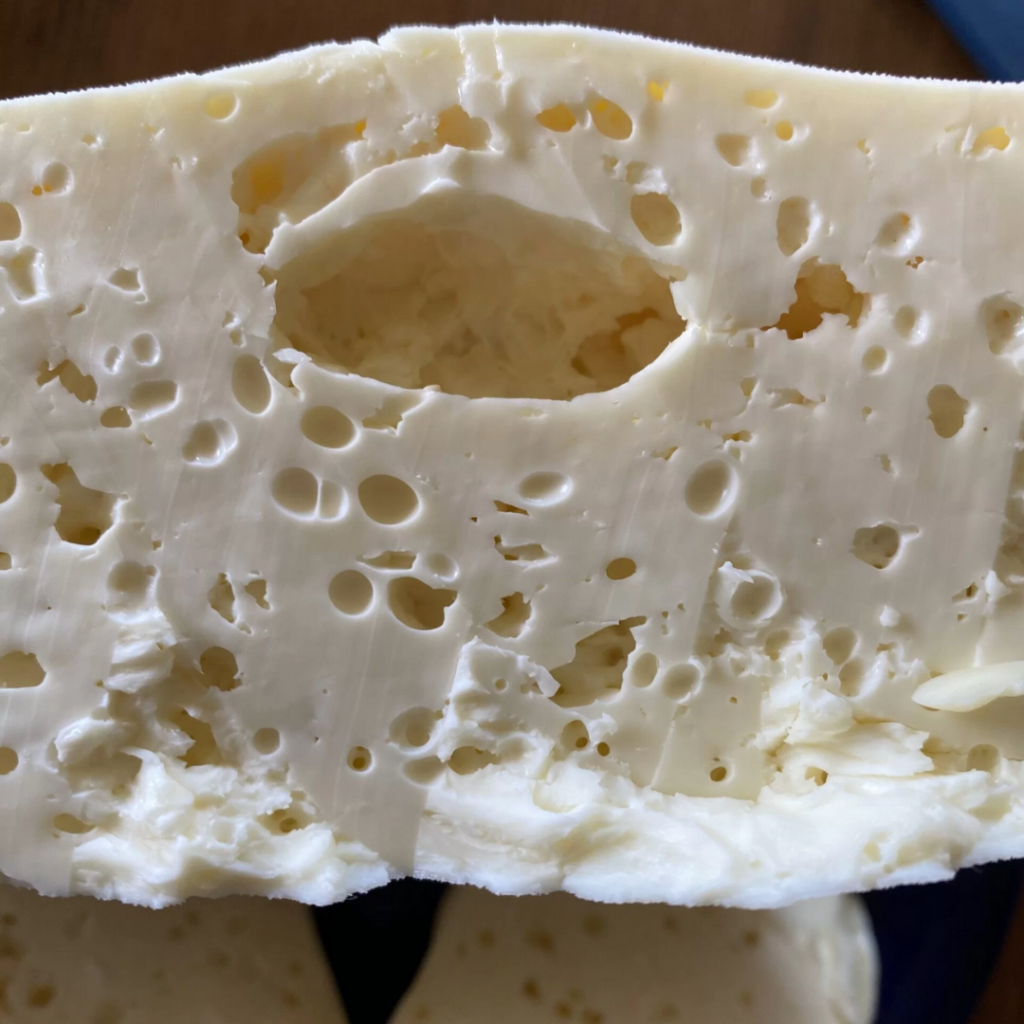
- Gas holes are holes caused by gas producing bacteria or yeasts and may indicate contamination. Gas holes include holes that are round, uniform and shiny. They look like a gas bubble popped and left a small cave.
- Mechanical holes are caused by mechanical error during cheesemaking. During cheesemaking moisture is trapped in the cheese and once absorbed, it creates a small fossil. Mechanical holes are usually sporadic, non uniform and upon close inspection, dull inside.
- Hybrid Gas and Mechanical. Sometimes it’s not so easy to diagnose a hole because it is caused by both mechanical error and gas. Gas production often occurs in moist areas of the cheese and since mechanical holes are caused by trapped in moisture, they sometimes create a hybrid hole. They can have features of both mechanical holes as well as gas holes.
Now that you understand how to tell if a hole is produced by gas or not, its time to figure out if this gas hole was created by a harmless microorganism or a harmful one.
When Gas Holes Are Normal
- Swiss style cheeses are made by adding in something called a propionic bacterial culture. During aging, this culture, combined with warmer aging temperatures causes hole or eye formation in the cheese.
- There are many different strains of bacteria that are used as starter cultures in cheese production, some cause mainly lactic acid production while others also cause gas production. For example, starter cultures such as those that contain the word aroma in the title, can cause intentional gas production in cheese.
- When raw milk is used in cheesemaking, or natural starter cultures such as clabber, gas production can naturally occur from harmless bacteria.
A few holes in cheeses that used these types of cultures in the making of them, or used raw milk is considered normal. On the other hand a lot of holes or something completely abnormal from usual, can also be indicative of contamination.
When to Be Cautious
I would be cautious if I saw cheese that had;
- A lot of holes are uniform throughout the paste of the cheese.
- A bad smell or taste.
- Was abnormal from anything I usually make.
Obviously this advice is quite vague, since without lab testing of our cheese we can never be 100% certain that the strains of bacteria we are seeing in our cheeses are safe. You always must remember my number one rule; Don’t lose sleep over cheese! If you are going to worry about it, it’s not worth it, just give it to the chickens and learn from your mistakes! On the other hand, the more cheese you make and the more experience you have under your belt, the more understanding you are going to have about what is normal and what is abnormal.
Top Tips for Avoiding Gas Production in Cheese
Here are my top tips for avoiding gas production in cheese so that you don’t have to wonder if it’s safe.
- Use good milk handling techniques when in the barn. If the milk is very dirty, don’t use it for cheesemaking. Clean and store the milk promptly after milking, especially in warmer climates.
- Sanitize and sterilise cheesemaking equipment, especially if you are using freeze dried cultures and pasteurised milk.
- When using raw milk, use the freshest possible and no older than 2-3 days.
- Use milk that has been stored properly.
- Always use good quality, strong starter cultures. For example, never use freeze dried culture that has been improperly stored (it should be stored in the freezer) and when using natural cultures such as clabber, use clabber that has been fed in the last 24 hours.
- Keep other ferments such as sourdough on the other side of the kitchen from your cheese.
- Salt cheese when and how the recipe asks you to. Salt is the referee in cheesemaking and it is going to slow down fermentation. Many gas holes are simply caused from over fermentation of cheese.
- Dry your cheese in a covered container in the cheese cave. Cheeses left to dry at room temperature risk getting too warm and having a surge of gas producing bacteria.
- If your cheese gets too warm during aging, expect a surge of gas producing bacteria. Try to keep the aging temperature as consistent as possible and never exceed 60F. I keep my cheese cave around 50F.
Applying these tips to your cheesemaking will limit contamination, as well as stop over fermentation, or a surge of gas producing bacteria.