
By Janelle Anderson
As I discuss this topic, I firmly believe the best possible model for a homestead family milk cow is one that is more sustainable and requires less or no inputs. Cows that fit this model exist, but I also know that most modern dairy cows do not fit that model.
As we discuss whether you can safely convert your modern dairy cow to a grass-fed only cow, there are a few things that I would like to cover. Arming yourself with knowledge of history, where the industry has gone over the years, and what type of animals we have available begins to paint a picture that lays out the difficulty of having modern-day dairy cows that are grass-fed only.
It is not impossible, though! I will provide some tips on choosing the right cow for grass-fed.
The History of the Dairy Industry
Dairy and its fermented and cultured by-products have always been a vital part of people’s diets throughout history. As populations grew, the need and demand for more production out of dairy cows changed many things within the cows themselves. In order to get more production out of milk cows, there were certain characteristics and traits that breeders coveted. It wasn’t just milk production that they were after, it was also growth rate, fat production, and the general health of the cows.
Keeping Things in Perspective
“In 1890 there were about 15 million cows kept for milk on farms. Their average (annual) production was about 2,700 lb. of milk and 115 lb. of butterfat. Knowledge of feeding and the production of efficient, low-cost feed supplies was limited.” R.E. Hodgson
Throughout the 1900s into the present day, increased milk production was and is at the top of the priorities for what breeders and producers worldwide are looking for.
In the US in 1952, the average annual yield per milk cow was 5335 lbs. The National Agricultural Statistics Service released the latest figures for 2024 and they show the annual average yield per cow was 22,908 lbs. If you check different sources, there are different numbers of yield, but all are over 20,000 lbs. An increased production like that in 70-plus years affects cows physiologically, metabolically, and even affects their structure.
While I don’t fault an industry that is trying to increase profitability for dairy farmers, what has happened is that small farmers or homesteaders who are looking for family milk cows are finding cows from a dairy industry that need massive amounts of grain, other supplementation, and pastures full of diverse forage to keep condition and production.
While I know that is a very brief history, I do believe it sets the stage for why it can be hard to convert a cow from grain-fed to grass-fed. The cows of today are larger, produce more milk, and are fed a lot more and those reasons are the most significant pieces of whether or not it is possible for most modern dairy cows to become grass fed only. I want to add a caveat: I am not saying that it is impossible to take some dairy cows and convert them to grass-fed only. Unless you have a firm grasp of nutrition and judging condition, I advise that you stay away from it.
Where I live in southern Middle Tennessee, there is a very big population of homesteaders who have dairy cows. I have been witness to more than a few trying to take the dairy cows they have purchased and transition them to grass only. I will be honest, not one of them has succeeded. Most were met with illness, mastitis, having problems re-breeding, and little to no milk production. And it wasn’t just one breed, it was Jerseys, Guernsey, Brown Swiss, Milking ShortHorn, and yes, even a Belfair. That isn’t even counting the plethora of online milkmaids who have shared with me that they have tried and failed at converting their cows also. To be fair, I do have a milkmaid friend or two who has successfully gone grass-fed. Grass-fed with lots of alfalfa pellets, supplemented high value hay, beet pulp, amongst other things.
I was having a conversation the other day with a very prominent milk cow educator, mentor, and friend who successfully runs a 60+ head herd of grass fed genetic cows & bulls. Within that conversation she made sure that I knew the success they have with keeping their grass fed herd in condition and health came after decades of breeding, intensive pasture rehab and rotational grazing, and diverse pasture paddocks that are cultivated specifically through all seasons to maximize the nutrient dense forage that is needed to meet their nutritional requirements. As well as really fantastic hay if needed. And sometimes, some of those gals need some grain supplementation.
What Will Make it Possible to Convert?
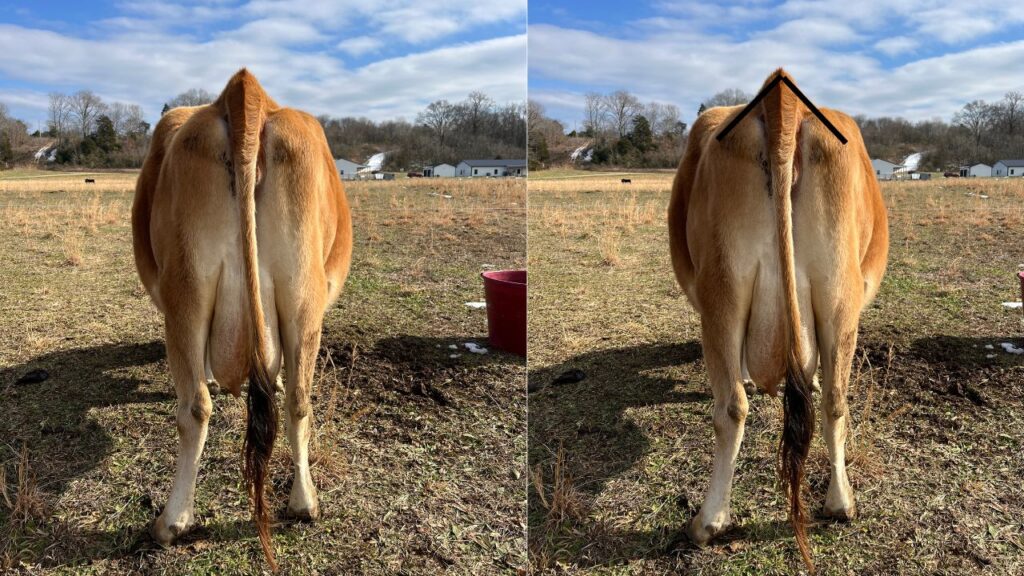
While a dairy cow’s rumen capacity is large, she cannot eat enough forage to meet her nutrient needs during peak lactation. One way to identify if a milk cow has the ability to hold more in her rumen is by looking at her structure.
The first picture is of my dairy cow, Molly. Molly is 900 lb, mid-size, purebred Jersey who produces almost 5.5 gallons a day at peak lactation. When accessing her from the back side, you can see that her frame is quite sharp and lends to a perceivable peak, which I marked in the second picture. What Molly has going for her is a bigger belly, which, believe it or not, is a good thing. It gives her more rumen capacity to break down forage. At peak lactation, she was getting 6lbs of 16% protein Dairy Ration and 6lbs cracked corn daily, along with 2 cups of black oil sunflower seeds, kelp and her mineral and salt. Those inputs were fed along with having decent diverse forage in the pasture that is managed by rotational grazing.
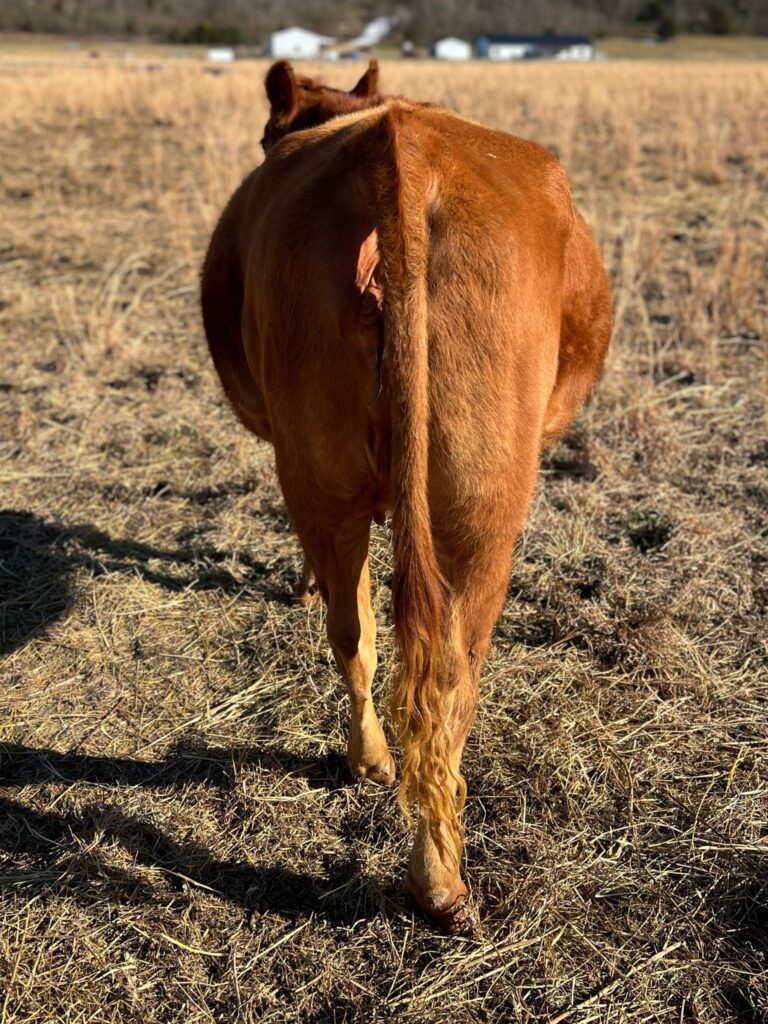
In contrast to Molly, the second cow, Sassy, has a frame that is more rounded. That rounded, wider structure allows her to hold more forage in her rumen. Combined with a bigger belly, this translates into additional forage capacity and turns it into the energy she needs while in lactation without the extra added grain inputs. Want a family milk cow that has the potential to be grass-fed only? Look for one with a more rounded frame. This type of frame may not guarantee her to be grass fed, but will make it more possible.
A History of Grass-Fed Genetics
In searching for a grass-fed cow, it is wise to look at milk cows with a legacy of grass-fed genetics, not just for one or two generations. The more generations that have produced cows that do well throughout their whole lactation on grass the bigger your chance of purchasing a cow from them that will continue to do so. In most of those lines, you will find a more rounded frame, a shorter stature, wider set-apart legs in the front, and a lower milk production than the average cow within that breed. I always like to share with people that even though you may have found a cow with those traits and genetics, be willing to steward your animal differently if her condition or health ever needs it.
Be Willing to Ask the Hard Questions
● Are you willing to feed grain if your cow needs it?
● How much production (milk) do you need daily, and can you afford the inputs a cow may need to keep that production?
● Can your pastures provide the nutrition needed year-round to keep your family milk cow as grass-fed only?
In Conclusion: Is it possible at all?
Yes. Truly, it is possible with some cows. My humble opinion is that successfully converting a grain fed cow to a grass fed comes down to feeding the cow correctly. What would I do if I wanted a grass-fed only cow? Choose a cross-breed or a heartier breed that has proven it can keep condition well during all seasons and lactation. Or find a farm that has PROVEN its cows carry condition well on grass only throughout their whole lactation cycle. Go into it knowing you may not get as much milk production as you had hoped for.
Secondly, choose a cow with the right frame. It’s not always cut and dry based on their structure, but it can help.
Thirdly, find a mentor who will be honest with you about your cow’s condition and allow them to. Lastly? Be willing to do whatever your cow needs nutritionally to keep them in good condition. They deserve that. In the end, we want you to thrive in your milkmaid era and your family milk cows provide you with nutritious, healthy milk.