

Oh, how 10 yr old me loathed the sound of the alarm on those school mornings when it was my week to do the morning milking of our family cow. How I desired to stay in bed just a few moments longer, and yet the responsibility was mine and if I didn’t get up and get it done, I might be late for school and that wasn’t an option either!!
The first family milk cow I remember was a large Holstein named Daisy. She’s the one I learned to milk, and good thing too, because she had beautiful long teats and was very gentle. Daisy is the one that gave me the confidence I needed when our family switched to Smokey, a very sassy and opinionated Jersey milk cow.
Myself and one of my siblings would take turns doing morning or evening milking, but regardless who’s turn it was for milking, we never had to walk alone to bring the cow home for milking. With 8 siblings there was always someone I could talk into walking through our 5 acres woods to convince the cow to leave behind her green grass and come to the barn for milking!
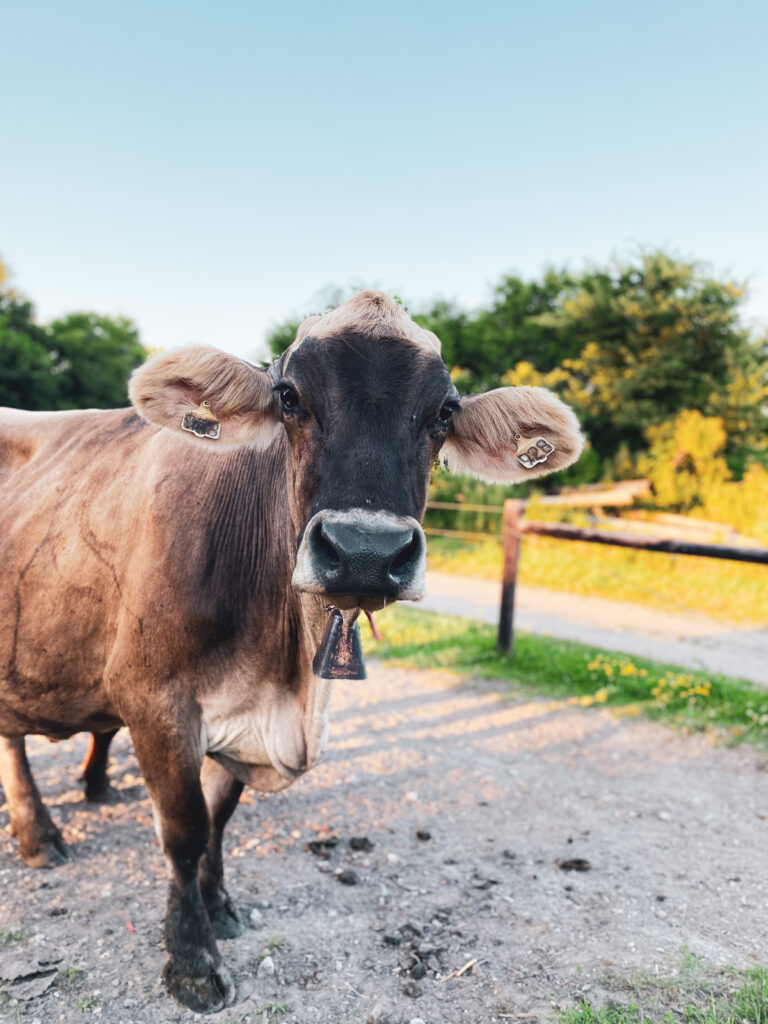
I believe these walks in the woods to bring the cows home, and the morning and evening jaunts to the barn, is where I began developing a deep love and appreciation for all things nature and seasons.
I believe that watching the cycle of birth and then experiencing the abundance of dairy after months of skimping planted seeds of appreciation for the species within me even as a young child.
The buckets of milk that we carted to the house found their way onto our table for family mealtimes in various forms. Fresh cream being my daddy’s favourite. I do believe that my daddy used more cream than anyone else I’ve ever known and yet, he was a thin man and some may even have called him skinny. In addition to the cream, there was plenty of raw milk, cheeses, and of course butter, generous amounts of butter flavoured every dish that appeared on our table.
Once or twice a week I’d ride my bike to grandma and grandpa’s house and help them around their small homestead. Most weeks grandma would need me to bring a couple gallons of raw milk for her and grandpa since they didn’t have their own milk cow anymore. The milk would ride in my bicycle basket for the 2 mile trek to grandma’s house.

Grandma would take one gallon and pour it into pitchers for fresh drinking and the other she would pour into a stock pot, cover it and push it into the back corner of her counter and say, “now clabber, Milk.” In winter she would set it on the shelf above her wood cook stove and tell it to “clabber.” My grandma used clabbered milk in all her baking, She used the clabber to make a couple different varieties of cheese, my favourite being Schmeirkase.
Schmeirkase (also called Amish Cup Cheese) is a cheese recipe that my ancestors brought with them to America around 1600 from their Swiss/German days. It’s a soft spreadable cheese we ate as a snack or light meal, spread on homemade bread, or with pretzels and crackers. Modern folks that have tasted it have likened its taste to that of French Brie but since I haven’t ever had brie, it just tastes like grandma’s cheese to me.
Grandma’s Schmeirkase
Ingredients
- 1 gallon Raw Skim Milk
- 1.5-2.0 tsp Baking Soda
- 1/4 cup Melted Butter
- 1 tsp Salt
- 3/4 cup Hot Water
Instructions
- Set milk in a warm undisturbed place until it's clabbered (thick like yogurt, and you might see it separate, curds and whey style). If you are starting with very fresh milk it's going to take longer to clabber. The reason for this is that the lactic acid bacteria that is naturally present in raw milk needs to multiply enough to ferment the milk. For this reason I like to start with milk that's been pushed to the back of the refrigerator and is already 4-5 days old. The lactic acid bacteria has had time to multiply, (much slower because of cooler temps) and it only takes a few days at this stage to clabber the milk once you set it out at room temperature.
- Heat your clabbered milk slowly to 125-128F. My grandma’s recipe didn't have a temperature recorded. It just read, "Heat until clabber is very hot, not boiling but too hot to keep your finger in it."
- Once the desired temp is reached, ladle or pour your curds and whey into a cheesecloth lined colander.
- Tie up the corners of your cheese cloth and drain the curds for 2-3 hours. (My grandma would take these dry curds, add a bit of fresh cream and a dash of salt, and eat them with fresh fruit. This was my first introduction to "cottage cheese" and I still prefer this cottage cheese over any other form of cottage cheese.)
- Once your curds are dry, and if you haven't eaten them all as cottage cheese yet, put them into a heavy bottom pot and add 1.5 – 2 tsp of baking soda.
- Stir in the baking soda well, making sure to break up any large curds. I use my hands here. Rest the curds and baking soda for 30 minutes to an hour.
- Add the butter, salt, and hot water.
- Heat over low heat, stirring all the while until curds are dissolved and cheese is smooth.
- Add seasonings if your prefer. Our new favorite is to add some chopped, dried jalapeños. It tastes just like queso.
- This cheese will store well covered, in the refrigerator for 2-3 weeks. Make sure you use wrap or wax paper down against the cheese to keep it from developing a dry "crust."