
By Rachel Hester
When I first began sharing about the dairy sheep, one of the most common questions I received was, ‘But HOW do you milk a sheep??’ The short answer is, ‘the same way you milk anything else’ and the smart Alec answer is “grab hold and don’t let go until your pail is filled!”
On a serious note, I think the question was more pertaining to a sheep’s temperament rather than its physiology. Sheep are notoriously skittish. Most people do not have experience interacting with these animals in the role of their shepherd, but rather as a visitor to a farm. Despite what most people think, sheep are in fact smart and do actually know who their shepherds are and can tell the difference between them and strangers. A ewe does not trust a stranger – she can smell the omnivorous nature of your diet and mistrusts your self control to start snacking on her leg right there on the spot.
A study by the Bramingham Institute concluded that sheep do not actually see their shepherds as humans, but rather funny looking sheep. They have accepted the shepherd’s role in the flock as head sheep. Lambs and Ewes get to know each other via nuances in their faces and voices, and so sheep learn their shepherd the same way. The study proved that sheep can recognize humans from photographs and after two years of not seeing a beloved shepherd, will start baa-ing the ‘lost sheep’ call when shown a photo of the shepherd. The pleasure centers of their brain will light up when shown the photo, indicating recognition and emotional attachment. Getting to this point in your relationship with your sheep is imperative in order to start milking her. You cannot simply walk into a field, grab a lactating ewe, expect her to cheerfully hop onto a stanchion and then sit quietly by while you handle one of her most sensitive vulnerable appendages to harvest food meant for her own young. She simply will not stand for it. The folks who have tried this will eventually win the argument, but rest assured it is in fact an argument and not a pleasant experience.
The first step towards milking a sheep is establishing yourself as her shepherd. This takes time, and it depends on the ewe how much time it will take. Some ewes will accept you within a month and others can take up to a year. Dairy specific breeds typically accept comparatively quickly and heritage breeds will take longer. In either case it will take far longer than a cow. Our Jersey stands quietly for complete strangers to milk her when we hire farm sitters while we travel. Our ewes want to know why we have brought a serial killer into the barn and flee.
The key to earning a ewe’s trust is pleasant experience and time. Take the time to learn what her favorite treats are and if she prefers ear scratches or chin scratches. Sit in the paddock with your ewes. I would bring my spinning wheel into the paddock or knit quietly and let the sheep come and sniff me without reaching for them when I first acquired my flock. If the only time the sheep interact with you is after a long day at work when you are tired, grumpy and impatient, it will take longer for them to trust you than if you spend lots of time with them and they see a plethora of emotions from you.
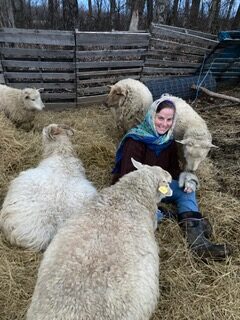
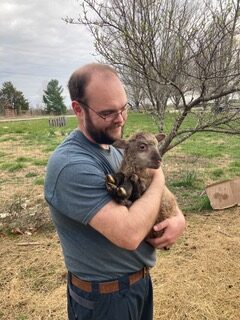
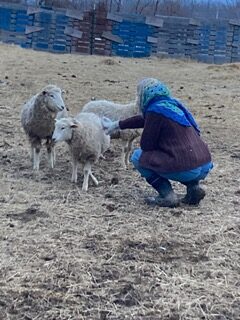
Once you are able to get the sheep to trust you and she will eat out of your hand, it’s now time to begin stanchion training. I describe the process in great detail in my book, ‘The Guide to Homestead Dairy sheep.’ I always recommend stanchion training begins a few months before lambing at minimum, or even as young lambs. The sooner you can start familiarizing your ewe with the stanchion, the better for everyone.
Once the ewe is stanchion trained, the next step is she must have a lamb and start lactating. Some ewes will produce an abundance of milk, such as in the case of an East Friesian, and you will need to milk her the day she drops lambs or risk mastitis. Other breeds will not have an abundance of milk and the lamb can harvest all the colostrum without any help. I always make sure I harvest some colostrum from each ewe each lambing so that I have a good supply in my freezer in case of rejected or orphaned lambs. Yes there is milk replacer, but in a dairy operation you really want your ewes especially to have the most premium diet possible so that their health is vibrant and she can reproduce long term and make prolific milk. Sheep are very resilient and can survive a lot, but if you want milk from her for your own family, it’s best to pamper them nutritionally from the get go.
I personally have not used a milking machine yet, I hand milk. There are some very nice milking machines on the market, and it is very easy to use those designed for milking goats in your ewe dairy operation. I prefer handmilking for a variety of reasons. First being that each udder is different and it is sometimes simpler to grab hold and squirt than it is to make sure all the attachments fit and stay on correctly. Handwashing is far quicker for me than machine washing. Finally when I get my hands on the udder it shows me tangibly what her udder health is, if she has any clotting issues or toughness in her bag and I can watch for illnesses such as Staph. Once we start milking more than six ewes per day I will probably have to switch to a machine, but that hasn’t happened yet.
Ewe teats are rarely on the bottom of the udder like a cow or goat’s. Sometimes you get lucky and get a ‘goaty udder’ but typically the teats are more to the side of the udder. This requires a little maneuvering with one’s hands to encourage milk into the teats and then milk out of the teats into the bucket and not on the floor or in your eye. Depending on the size of sheep this quickly gets challenging.
I overcome this by milking not into a pail, but into a lightweight plastic cup that I dump into a stainless steel milking pail when it’s full. This allows me to follow the milk stream with the cup, and avoid the ewe spilling the milking bucket or adding other liquids into the milk pail besides milk.
Some sheep have gorgeous teats that are quite easy to grab hold of. These you simply squirt the milk out of the same way as with a cow or goat. Some ewes have ‘jelly bean teats’ and it is actually easier to milk them with the help of an EZ milker or milking machine with attachments for Nigerian Dwarf goats. I have hand milked ‘jelly bean teated’ sheep before – with my fourth finger and pinkie. It is possible but not very enjoyable and once we bred some better milkers into our program I retired that ewe into our ‘breeding lambs for the freezer’ program and phased her out of our dairy program.
You can milk the smaller teats with your index finger as well, just be careful because sheep udders are much more sensitive and pliable than cow udders. It is easy to stretch the teats by accident and cause issues down the road if you aren’t careful to keep your hands and fingers very firm so that you are simply squirting and not stretching.

Some shepherds are blessed with ewes who have excellent temperaments and ideal udders, so can place a stainless steel bucket under the udder like normal milkmaids and picturesquely squirt their white gold into the silver bucket the way Social Media and Artwork intended. These genes are not super rare in the United States but might be more readily accessible in Canada. You can selectively breed your flock for this kind of teat placement on your sheep’s udders, but just be aware this is a process that will take time. The majority of dairy shepherds will not sell their best animal. You are usually getting culls or unproven females and so will have to spend some time getting to know your genetics and learn what you want to breed for. The nice thing is that, where sheep have such a short gestation time, you can improve your flock relatively quickly in a few years.
Udder shape and conformation can become the primary factor some dairy shepherds breed for. While there is definite merit in keeping a good udder and teat placement in mind, it should not be the ONLY trait one breeds for. Keeping mothering instincts intact, thriving on the pasture and feed input that works for your farm, parasite resistance, and watching milk volume and cream content are just a few of the factors to bear in mind with selective breeding. Getting laser focused on one or two traits in a dairy flock leads to very fragile and unthrifty sheep and a poor milk harvest.
There are some breeds like the East Friesian who can tend to have better udders the younger they are bred. A friend of mine who breeds near-full-blood East Friesians says if she doesn’t breed her ewes within the first year of their life, they put too much fat stores in their udder and it becomes hard to milk. Conversely, with my ewes of mixed breed ancestry with a good deal of heritage breeds mixed in, I find that giving them eighteen months to a year of growth before breeding allows them to fully develop their reproductive organs, which leads to better long term health of the ewe, her udder, and her offspring. When a Gulf Coast Native ewe escaped and bred in her first year, she had no issues carrying the lamb to term and delivering it unassisted. However since her uterus hadn’t fully developed, the lamb was crippled from the navel down. Her front end conformation was beautiful and regal, but her back legs were not attached well to her spine and she was weak and deformed. We sadly had to cull her as she deteriorated the older she grew. The mother ewe also has one of the most difficult udders to milk. It is oddly shaped with tiny teats. Her sister who was not bred until she was two and a half years as a nice large udder for her breed and teats that are a dream to milk.
If you want to start an argument amongst shepherds, ask when it’s wise to breed new ewes and watch the drama unfold. Very few of us can agree civilly to disagree when it comes to management styles! We are passionate about our sheep…and everyone else’s apparently.
Another area of controversy, at least amongst American milkmaids, is to grain or not to grain. The ideal of grass-fed milk is not without virtue, as molecularly it is a healthier product with far more healing properties than grain fed milk. That being said, very few of us inherited pastures with the deep topsoil and rich diversity of forage necessary to maintain the health of our dairy animals. Furthermore, most of us only have access to animals who have been bred for several generations to survive with grains.
My homestead is in the Appalachian foothills of Kentucky. Historically this was never farmland, and our particular eight acre plot was used for far too many years as hayfields which strip-mined what topsoil we had. The final injury against my dairy program was the previous farmers were enamored with Fescue, which is not the most nutrient dense forage, especially when riddled with endophytes.
Our goal is grass fed milk, however we must be mindful of our sheep’s nutritional needs. The American South has soil which carries high parasite loads which leach nutrients out of a sheep’s digestive system. In order to fight off the parasite attacks and still be able to produce lots of milk, our sheep require some nutritional help. Additionally, my heritage breeds find it quite reprehensible to contemplate simply GIVING me milk without payment of some sort. The Gulf Coasts especially simply will not stand for milking without bribery.
Sheep’s digestive systems are quite sensitive to over acidification, so I must be mindful to feed them slow fermenting grains and keeping their rumen pH at healthy levels. Over acidified animals are also more susceptible to parasite attacks.
Soaking grains overnight helps address this and adds a beneficial fermentation to the feed, which improves their gut health like it does ours. My personal stanchion mix consists of alfalfa, beet, and lespedeza pellets (lespedeza adding some parasite resistance to the sheep), sunflower and flax seeds, barley, oats and sometimes wheat berries. I take about two and a half gallons of this mix and, in five gallon buckets, add about two gallons of water and about a quart of whey. It can be cow or sheep whey, but the minerals and probiotics of the whey do wonders to help the sheep’s gut health. I can also add some apple cider vinegar if I am out of whey. While it may sound odd to feed a sheep back whey of her own production, old time shepherds always gave their ewes some of her own milk to drink in order to replace lost calcium and give her liquid nutrients she could easily digest. Much like feeding chickens their eggshells back to them for replacing calcium.
There are quite a few more nuances to milking sheep than there are to milking cows. We purchased our Jersey cow after milking sheep for a few seasons and were shocked at how much easier in temperament and care the cow was in comparison to the sheep. Once you have earned your ewe’s trust, trained her to the stanchion, figured out her nutritional needs on your available pastures, and learned the nuances of her particular udder, you will feel as I do that the milk you harvest is white gold. It is definitely worth it!