
By Tamara Camber
What Is Mastitis?
Mastitis in simple terms that we can understand is inflammation in a cows udder. When we think of inflammation in a cows udder, mastitis is usually the first to come to mind. There’s two causes of inflammation. One would be an injury to the quarter, two would be caused by a bacterial infection usually associated to environment.
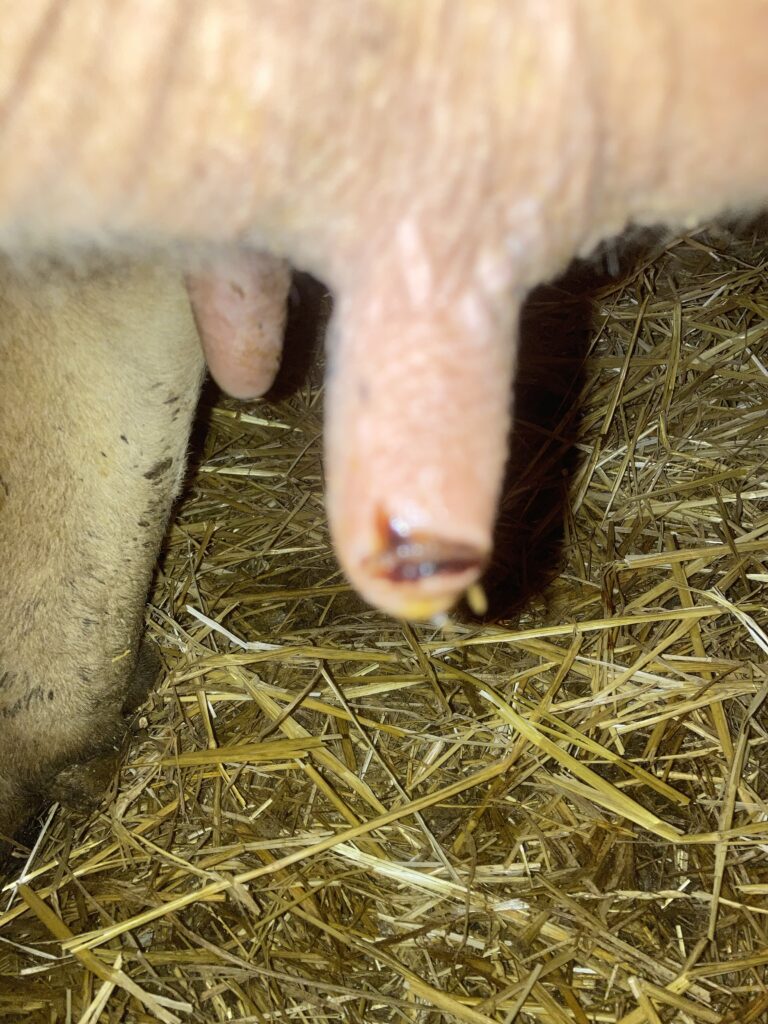
Lets’ face it, injuries happen. The scenarios are endless. Recently my small jersey tripped and cut her teat. There was a laceration that reached half way around the lower end of the teat. The injury was quite sever but we were able to treat her on farm. An injury like this can introduce bacteria to the area causing a localized infection. Without treatment it can cause more serious outcomes such as gangrene, where she could lose the teat or possibly the whole quarter. Another common injury could be being kicked by another cow, although in my years working with dairy cows I have never seen this kind of injury but I have heard of it happing with goats.
The second cause of Mastitis is bacterial. You may be wondering, “how can bacteria enter into the udder without an injury?” Well the answer is simple. Bacteria can enter through an open teat end, traveling up the teat canal, then into the udder. Inflammation and infection can be described in various degrees of severity. This is where things can get a little more complicated. Depending on the bacteria, the udder can present with redness, swelling and heat. In most cases mastitis is painful for the cow. In severe cases your cow may show systemic signs. This may include depression, fever, off-feed, hard swollen quarter and decreased milk. Occasionally in the most sever cases, death.
Types Of Mastitis
Mastitis falls into five categories; subclinical mastitis, clinical mastitis, acute mastitis, acute gangrenous mastitis and chronic mastitis. Each category has its own symptoms, bacteria and treatments. Below is a brief description of each category, but keep in mind that testing would be necessary to further investigate the bacteria specific infections.
Subclinical Mastitis
✔️No Visible Signs
✔️Testing Indicates Elevated Somatic Cell Count
✔️ Treatment may or may not be required
Clinical Mastitis
✔️ May present with depression and fever
✔️There will be changes in the udder and milk. Which may include; swelling, heat, redness, pain, and flakes or clumps in the milk.
Acute Mastitis
✔️ Associated with Klebsiella, Strep Spp and E.coli.
✔️ The udder will be hard, swollen and extremely painful! Milk will present with clots and may be watery.
✔️ Cows will loose appetite, act depressed, and present with fever.
Acute Gangrenous Mastitis
✔️ Cow may present with dehydration, fever, anorexia, and more serious health conditions that could lead to death.
✔️ Treatment should be immediate for best outcome.
✔️ Associated with S. Aureus, Cl. Perfringens and E.coli.
Chronic Mastitis
✔️ Will present with acute infections with prolonged intervals.
✔️ High somatic cell counts
✔️ Often carries coagulase-negative staphylococci, S. aureus and S. uberis bacterias. Often cows will be culled as milk is no longer fit for human consumption.
Figuring Out What Kind Of Mastitis You Are Dealing With
One way to confirm the type of bacteria present would be to contact your veterinarian and arrange a milk culture. With technology advancing, testing somatic cell counts, and culturing milk are becoming a valuable tool for both commercial and the family milk cow. Somatic cell testing in inexpensive and easy to access in both the USA and Canada. Culturing milk samples requires a larger investment.
I have found a couple testing methods that I keep on hand. The first one is the PortaSCC test or Quick Somatic Cell Test for Subclinical Mastitis. The tests come in a kit of 12. These tests can be done cow side. Results take 5 minutes. The tests give you a number range of somatic cells in the milk. The darker the blue the higher the count. They can be purchased at www.farmersdepot.ca.
Other testing methods are the CMT test. This test can be purchased at most local feed stores or veterinarian offices. It can also be purchased online at www.farmersdepot.ca
When it comes to diagnostics and lab culturing, technology has come a long way. It used to be that all of these tests had to be done at specialized labs that only veterinarians new about. Now we can do this at home. It takes a little bit of time to learn how to do it, and some monetary investments.
I have purchased a home culturing kit for my four dairy ladies. I have found that it saves me time and money. I purchased my kit at www.leedstone.com. Keep in mind this company is out of the USA and shipping and duty charges apply when shipping into Canada. The incubator is a basic chick incubator and must hold a temperature of 34-38 degrees Celsius. If you are using your chick incubator it should be sterile. I have one for chicks and one for milk cultures.
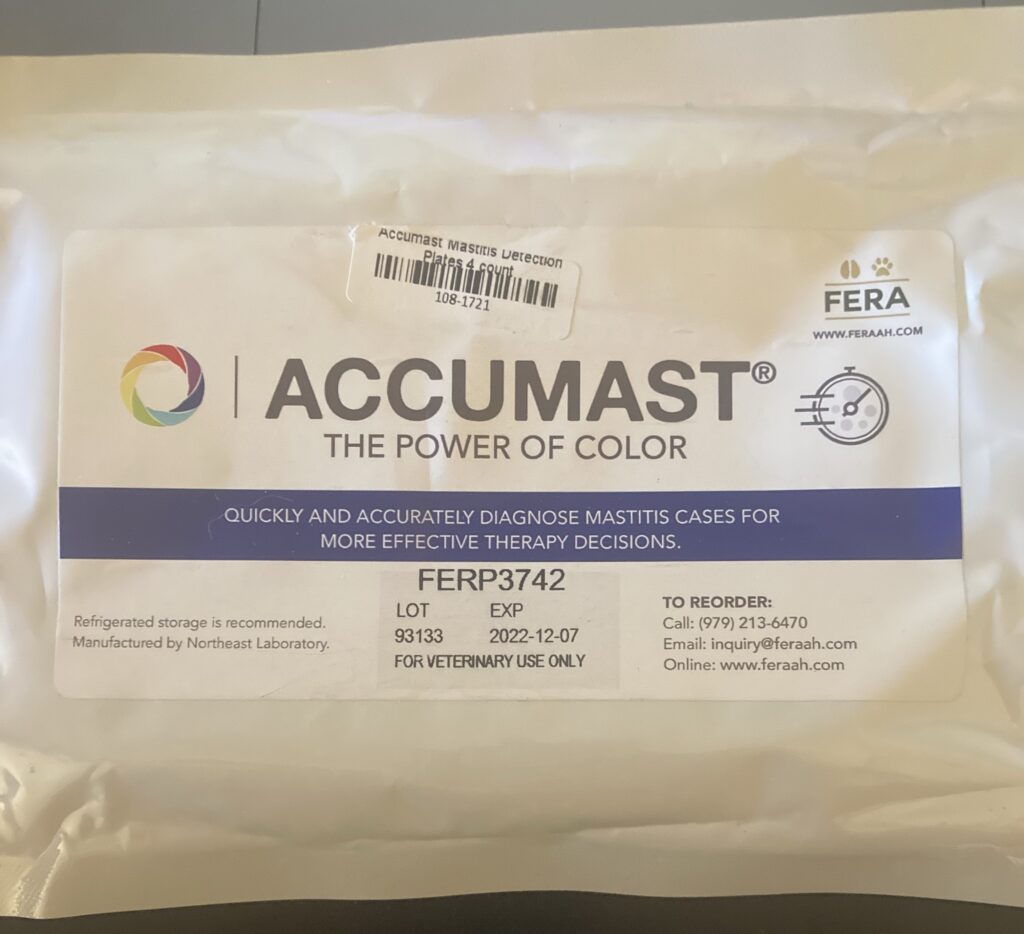
I also ordered the Accumast detection tri-plates. These are so handy to keep on hand. You have results in about 18 hours. So treatments can start right away. The diagnostic book can be downloaded here.
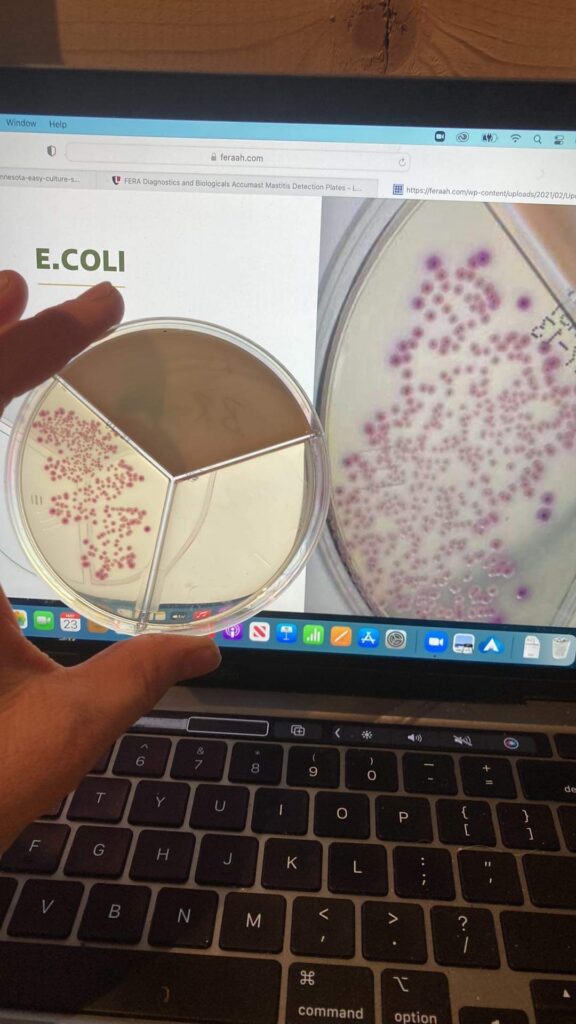
Above is a test sample I took from one of my jerseys after repeated infections. The test result shows E-coli in the pink spots. But it also shows a second infection in the top of the plate that has a blue tinge. This indicates she also has strep. All of this in one quarter. At the back of the book it gives a treatment for each diagnoses, as well as the possible outcome. After 14 days of treatment I cultured the milk again. I don’t have the slide, but it also indicated strep. So now we are treating her with an inter-mammary antibiotic for 8 days. Five days after treatment her milk can be cultured again.
Making A Treatment Plan
Once you have a diagnoses, be it from your veterinarian or a home culture kit. You can discuss a treatment plan with your veterinarian. Sometimes it helps to take the tri-plate to your vet so they can see the results. For E.coli a recommended treatment would be IV antibiotics. You may have to take your cow in to see the vet or the vet may come to your farm. The type of bacteria will indicate if you should use an antibiotic or a natural treatment. In my jerseys case, she needed an aggressive treatment plan to get her feeling back to herself. Natural remedies have their place. Having milk cultured, will ensure you are giving your cow the right treatment.
Reducing The Risk
The best way to treat mastitis is to avoid it. Unfortunately it can still happen despite our best efforts. Hygiene is a big deal. Using a pre and post iodine teat dip can really help. Making sure we are milking with clean hands. If you are using a milk machine, it is just as important to be making sure we have clean hands. A dirty milk claw, or soiled hands can transfer an infection from one cow to another, or from one quarter to another.
We also want to look at the environment that our cows are living in.
Unfortunately when we were preparing our dairy herd to move to a new province, we had to house them on the neighbours feed lot. It was because of this two of my jersey cows have had both subclinical and acute mastitis. Once a cow has had an infection in her quarter, she is prone to subsequent infections in the future. Making sure their bedding is clean and dry will help to ensure they stay happy and healthy.

Tamara Camber
My name is Tamara. My family and I moved to British Columbia from Peace River, Alberta in October 2021. We sold our acreage and decided to embark on a ranching adventure with my parents. My husband and I packed up, bringing our six children, 36 head of dairy and dairy cross cattle, 54 hens, six cats, four dogs, farm equipment and a small amount of house hold goods. Somewhere along the way we acquired 3 extra beef calves. Before moving into British Columbia, we were living self sustainable life style, producing 90% of our food. Although it’s taking a little time, we are almost set up here.
Citations