
By Lacey Yates
As a stay at home, homeschooling mom of four, I’m always looking for quicker ways to preserve milk out of my herd of dairy goats and the milk cow. While having both species in milk at the same time is a blessing, I do find there are instances when I’m swimming in milk. To preserve larger quantities of fresh milk, I try to turn it into an aged cheese such as cheddars, parmesan, and blues. I will admit that there are many times I find myself not having quite the time allotment available that some of these cheeses can take. My go to for milk preservation has been an adapted recipe of cheese curds!
The original recipe can be found on New England Cheesemaking if you are interested in an extended and slightly more complicated version. However, I prefer my adapted recipe. It can be done quickly, with very minimum hands on time! That means I can begin a large pot of curds shortly after completion of milking, multi task during the actual curd making (most of the time that means getting some school done with the kids), and finish up before lunch needs to be made.
I’ve made this hundreds of times with both species of milk, and it’s NEVER failed. Another plus, no adjustments need to be made using cow or goat milk! Want to double the recipe? That works perfectly fine. Half the recipe? Sure!
These curds can be froze if you’d like, but we go through them quickly. Toss them with ranch seasoning, salt and pepper, garlic and dill, buffalo wing sauce… the sky’s the limit. They are also fabulous breaded and fried. You can even adjust the way you cut the finely curd and cut them into sticks to bread and fry.
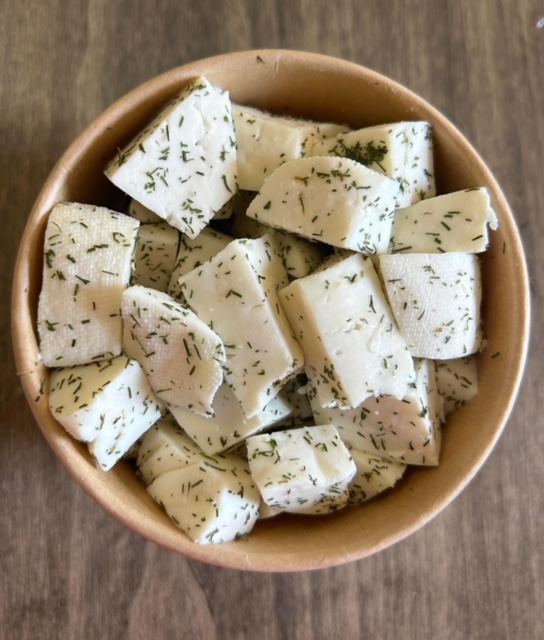
Cheese Curds
Ingredients
- 2 gallons whole raw milk
- 1/8 tsp thermophilic culture
- 1/2 tsp rennet
Instructions
- Use fresh milk or heat milk to 96 degrees.
- Culture milk and ripen 30 minutes.
- Coagulate – add rennet and set 18-25 minutes or until you get a clean break.
- Cut curd into 3/4" grid. Heal 3 minutes between cuts. Begin stirring at 96 degrees.
- Heat to 116 degrees over 30 minutes. Continue to cook curd another 10-60 minutes while holding 116. (This will depend on how dry you want your final curds to be, upon other factors. I find mine are just right when curds are slightly softer than "gum" like texture.)
- Line colander with tea towel and strain curd. Gather and twist cloth to press under plate around 8 pounds of pressure for 15 minutes – 3 hours. (This varies greatly, just check it if you're curious. You're looking for a firm curd mass that's completely knit together.)
- Cut into bit size pieces and salt (4 tsp/2 gallons) and season with whatever you prefer.