By Natalie Nickols
What’s up Milkmaid Society? I’m Natalie from Nickols Family Homestead in northern Indiana. We started homesteading a few years ago and let’s just say we didn’t dip our toe in the water to get started. We did a big ole’ canon ball in the deep end. About a year and a half after we moved onto our 5 acre property, we had 50-60 laying hens, meat birds, feeder pigs, a breeding trio of pigs, a roughly 3,000 sq ft garden, two dogs, and a milk cow (that soon turned into two and a local raw milk herd share). I have what they call an “all or nothing” personality. It’s been crazy but also pretty great! Kind of like drinking from a fire hose with the amount of learning we’ve done in just a few short years. I’m the first to admit that I’m the expert in almost nothing but we HAVE learned so many valuable things in our homesteading experience so far.
One of the first animals we purchased was feeder pigs because, hello bacon! We had one gilt that was sweet tempered and always really healthy, so we decided to retain her for breeding. We named her Penny and then we purchased our Old Spot boar, Norman. Our first litter was born the following spring. I have to give a plug for @themoderndaysettler on instagram because as soon as we decided we were going to try out breeding pigs, I joined her patreon. That is where I learned most of what I know about pigs in general. Kate is an absolute wealth of knowledge.
Overall, we’ve had three litters of piglets on our homestead and farrowing has a very special place in my heart. We’ve decided to stop breeding pigs for now because the herd share is a more profitable endeavor for us with our local market. There is also only so much room on a plate and something had to go. The excess of milk we’ve had, made keeping pigs doable for us for a long time though. Especially when Penny had a ginormous litter last Spring.
Spring on the Homestead
Spring is such a glorious time on a homestead! The earth is coming back to life after sleeping all winter. So many babies are being born. Ducklings, chicks, piglets, and calves, oh my! It’s the best. It’s also pretty insane for those of us who live the agrarian lifestyle. This past Spring was no different. I was eagerly awaiting Penny’s third farrowing. Her belly was huge and I was curious to see how many she had in there. Piglets are also just the cutest. One morning I noticed she had started nesting. She was grabbing all of the fresh straw I’d given her and arranging her nest that she’d give birth in. I immediately looked at the run down from her last two farrowings and saw that we probably had about 12-18 hours until we saw a piglet. I monitored her all day and we decided not to cancel our evening plans because not much was happening. I checked on her late that night before I went to bed and she was totally fine, just snoozin’ away. I woke up around 2am and something told me to go out and check on her. I threw on my boots without socks and didn’t put my contacts in or anything. When I got out there to her, she already had three piglets on the ground. They were strong and nursing and I was kicking myself for wearing my glasses instead of just taking the extra thirty seconds to put my contacts in.
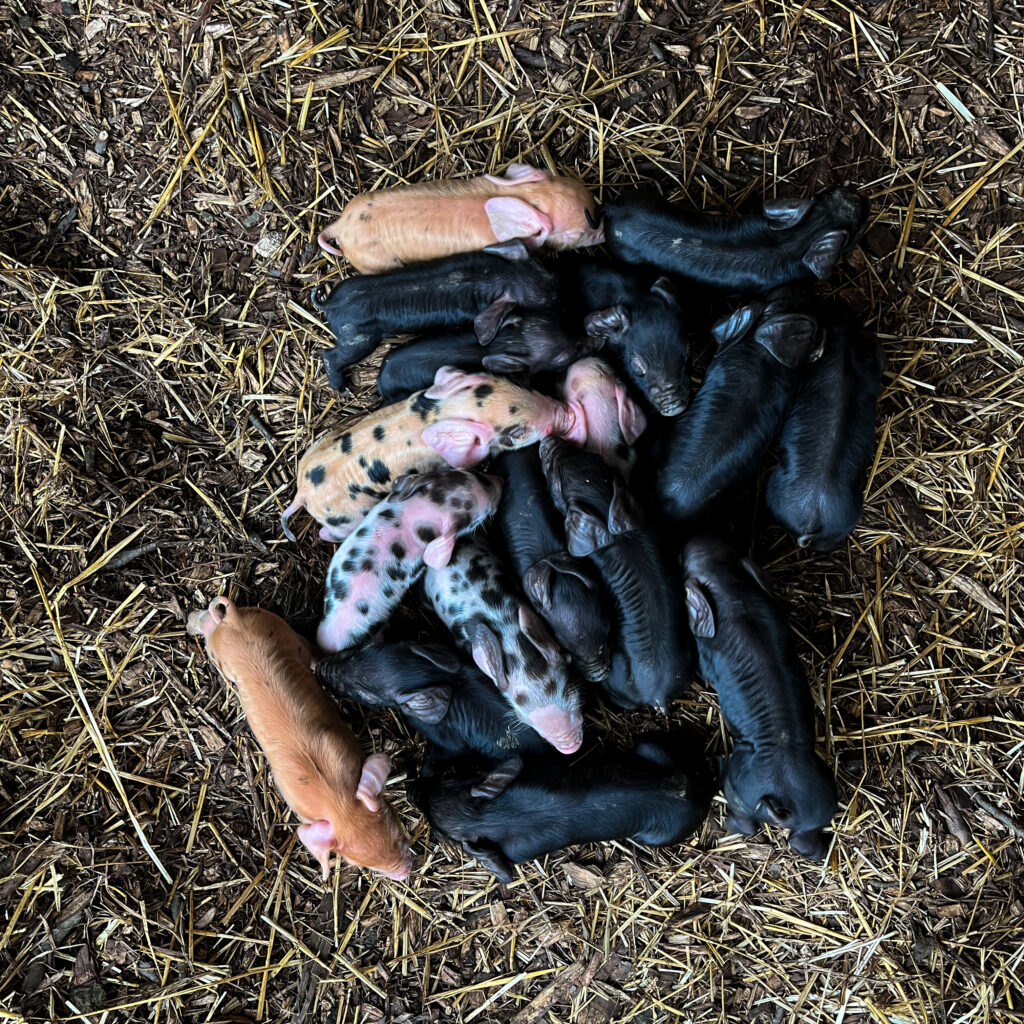
I stayed out there with her for the entire farrowing. (Disclaimer: our sow fully trusted me and was not agitated in the least for me to be present with her while she farrowed. Not all sows can be trusted like this.) The piglet count went up to 8, and then all of a sudden we hit 10. Pretty soon she had delivered a few more. Once we hit 14, I started getting a little nervous that she had a monster litter in there. I could tell she wasn’t done. Then came 15, 16, 17, and EIGHTEEN! Oh my word, I could not believe it! Then her last piglet, a stillborn, was born right before her two placentas. She gave birth to a total of 19, 18 live babies. Penny had 15 teats. If you leave all of the piglets with mama for a littler this size, most likely some will get starved out and die. We gave her about 12 hours to see if she could feed them all but it was obvious she couldn’t. We pulled the few that seemed to not have eaten and brought them inside to hand raise. One had been injured and didn’t make it.
Hand Raising Piglets
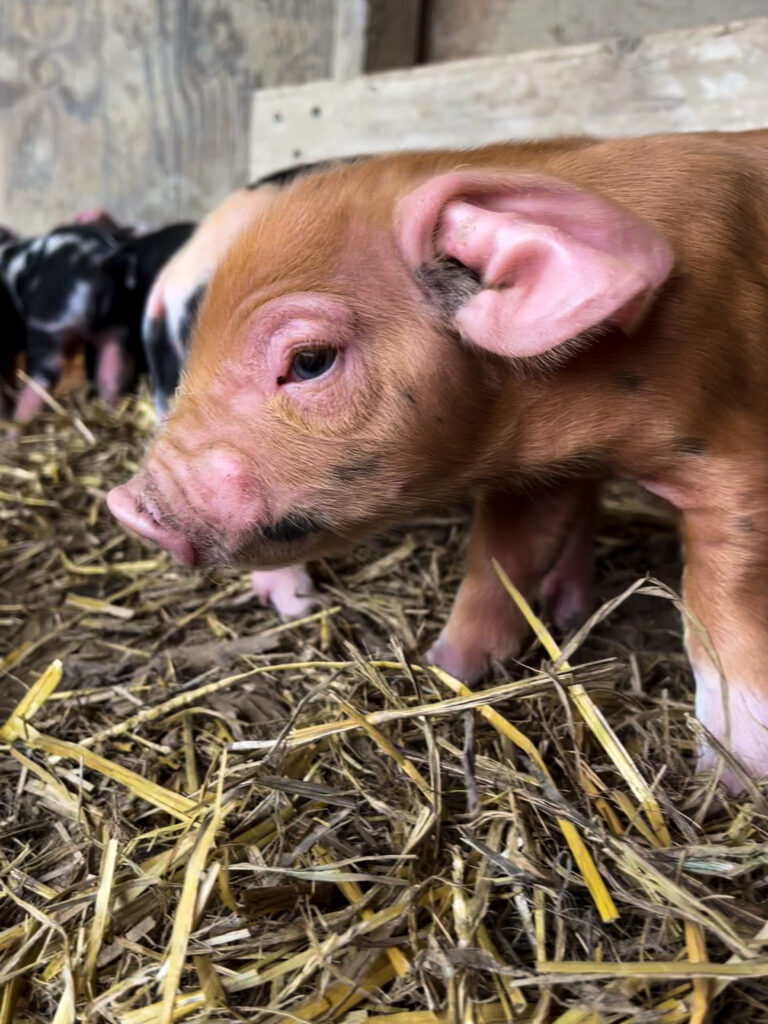
Hand raising piglets is A TON of work. Thankfully, we had plenty of milk from our dairy cows. I learned that cows milk has double the fat content of pig milk so we fed them half water/half milk after a few days of cow colostrum from the freezer. I fed them every couple hours around the clock for a few days and then spaced the feedings out a couple more hours. It literally felt like I had a few newborns. We started with syringe feeding and then trained them to pan feeding which took about a day of really consistent, messy feedings until they got the hang of it. We kept them in two bins, one with dry bedding and a heat lamp for sleeping, and one that could get messy that we’d only use to feed them in. Every few hours, I’d have to heat up milk, pour it into the pan, put them in the feeding bin until they were finished, dry them off while they screeched, and then put them back in their dry bin. We gradually weaned them down to four feedings a day and purchased “Pick of the Litter” piglet starter feed from Kalmbach. Mixing in grain with the milk is a process that has to be done SO carefully. We had one rectal prolapse that resolved and one that we ended up having to cull, unfortunately.
When we first started transitioning them to grain, we added a little to a bowl of milk that had soaked for 15 minutes or so and left that in there for them to try. We occasionally gave them a little dry grain to see if they could handle it and that’s when the prolapse happened. I cannot emphasize enough that the transition to grain needs to be gradual, and please always soak it for a good while.
I cannot imagine what we’d have done if we didn’t have the extra milk from our cows to feed the piglets. That would have been an absolute ton of milk replacer, and quite expensive as well. They thrived and grew so well on cows milk that it makes me wonder if we could raise them all the way out with scraps, excess milk or whey, and only need to purchase minimal grain. We plan to experiment more with this in the future.