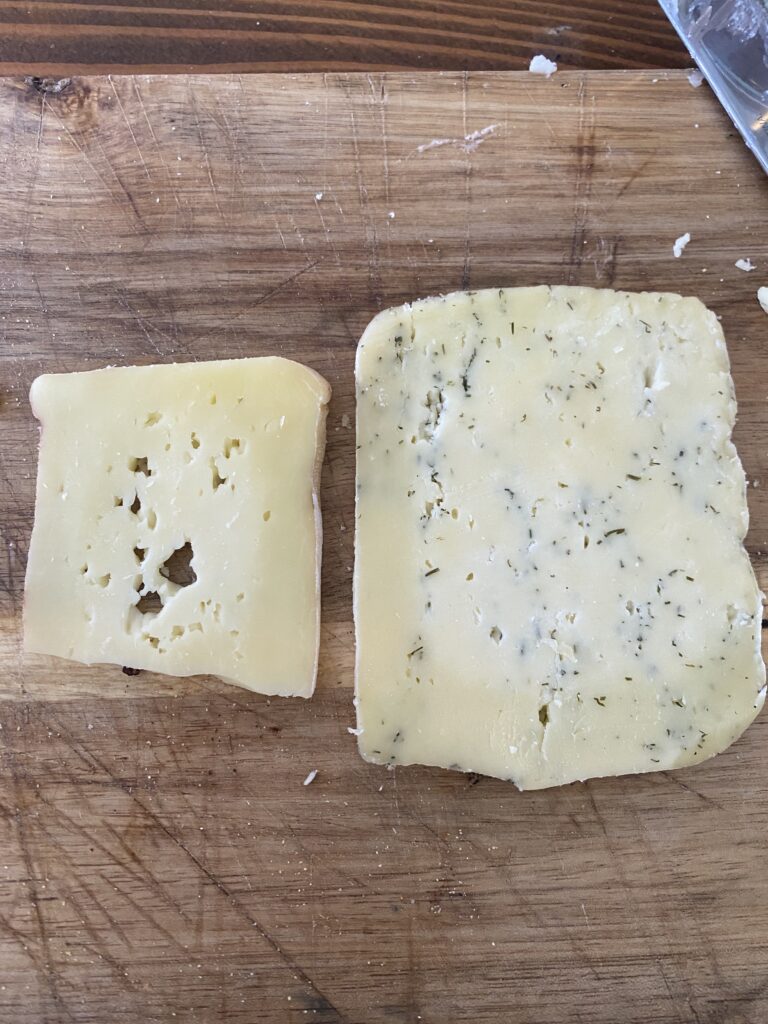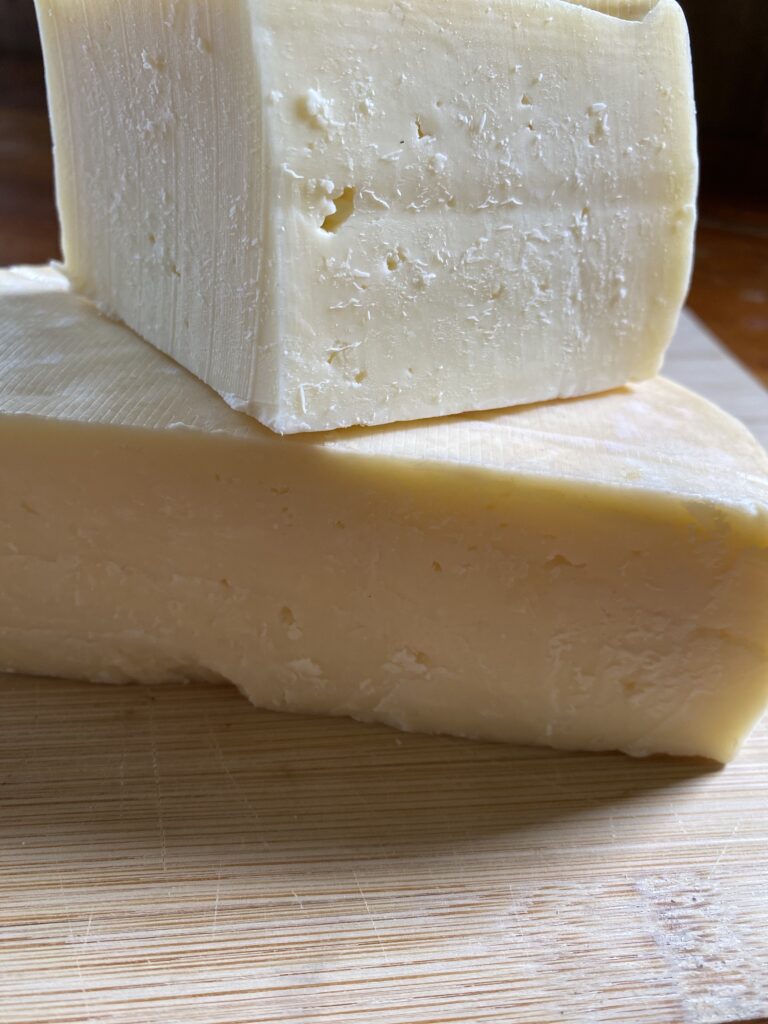
Mechanical holes can be caused from many different things and contrary to popular belief, they are not just from underpressing. In fact the most severe cases of mechanical holes are very rarely from underpressing but a combination of too much weight at the beginning of pressing and under stirring.
The Cause of Mechanical Holes Depends A Lot On The Type Of Cheese
Hard Pressed Cheese
Hard pressed cheeses such as cheddars, parmesans, asiago, or any other dense cheese are the most prone to mechanical holes caused by Under Pressing. These types of cheeses do not contain a lot of moisture in their curds.
To understand this, lets look at how pressing cheese works.
When you press cheese, what you are aiming to do is NOT to push the whey out of the curds, but rather to push the whey out from between the curds. The curds will drain by themselves! The purpose of pressing cheese, is to push out this drained whey, but also to knit the curds together.
Because harder cheeses have less moisture within the curds, you are less worried about locking moisture into the cheese, and more worried about making sure you apply enough pressure to knit the curds together.
If you have a cheese that is one of the harder varieties, chances are your mechanical holes are caused by under pressing and next time you can rectify this by upping the pressure.
Softer Pressed Cheeses
Softer Cheeses such as washed curd cheeses like gouda or havarti pack a lot of moisture within their curds. The shorter stirring time of these cheeses, also leaves them at a higher risk for uneven curds, and may leave your cheese pot with larger curds that carry more moisture than the rest.
The hazard behind pressing moist curds is that it is very easy to use too much weight during the start of pressing and instead of only pressing the moisture out from between the curds, you press moisture out from within the curds. This causes the outside rind to dry prematurely and leaves moisture locked inside. In my experience, this is the most common cause for severe mechanical holes. To solve the problem of moist cheeses that are riddled with mechanical holes, try applying a lower pressure for the first 15-30 min of pressing, followed by a higher pressure.
Be sure that you are stirring your curds long enough. As I have mentioned above, very moist cheeses do not do well under high pressure. They carry too much moisture within there curds, and this moisture can easily be pressed out from within them. For example, cheeses like feta and brie, have moist enough curds that they use their own weight to press themselves. If you are not stirring your curds for a pressed cheese recipe long enough (many recipes state a desired feeling of the curds for end of stirring), you risk trying to press a cheese that has too much moisture.
Lastly and tail coating off my last point, is uneven curds can easily cause mechanical holes. This is because while the smaller, even curds drain at a similar rate, uneven curds are larger, take up more space and take longer to drain. To mitigate this problem during cheesemaking, it is important to spend the first 5 minutes of your stirring stage working to bring all of your curds down to a similar size. This will greatly reduce the amount of uneven curds you have at the end of your stirring stage.