By Rachel Hester
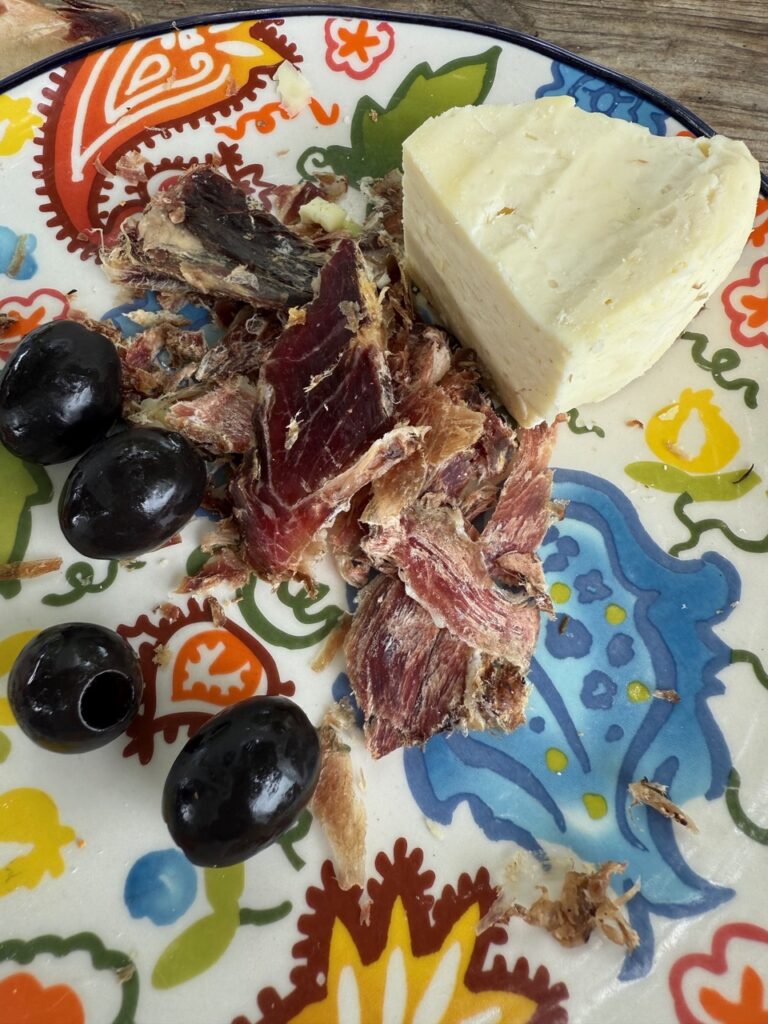
When making cheese from sheep milk, some cheesemakers are shocked to discover that their cow milk recipes do not in fact produce a delightful, creamy nutty ambrosia that sheep’s milk cheese’s reputation describes. In fact, they often discover to their chagrin that the cheese is tough, tastes funny, is rubbery, and altogether not that nice.
Sheep milk is similar to the animal it comes from – it wants to be treated gently, softly, tenderly, with respect to its nature. When cheesemaking, it is important to use recipes designed for the species of milk you are using. If these are unavailable, knowing some key factors about the difference between cow milk and sheep milk will help enthusiastic dairy shepherds know how to adjust recipes to get a result they are happy with.

The components that make sheep milk a more nutrient dense food product also affect the techniques used for cheesemaking. Sheep milk typically uses about 1/4-1/2 the amount of rennet that cows milk requires in cheesemaking. In Olivia Mill’s book, ‘Practical Sheep Dairying,’ (which is tragically out of print) she shares that ewe’s milk requires about 3mL of rennet to one liter of milk.
As I’m sure you know at this point, rennet contains enzymes, chymosin and pepsin, that predigest the milk and curdle it – which is where the name ‘curds’ in cheesemaking probably comes from. Sheep’s milk is naturally high in enzymes, low in sugars, and high in minerals that our bodies use to create digestive acids and enzymes. All these factors affect its need for rennet. This also means that curds will form faster with ewe’s milk than with cow’s milk.
Sheep’s milk fats and proteins are smaller and smoother in shape. There are less saturated fats found in sheep’s milk, and it is naturally homogenized, which can make butter making challenging. Traditionally, ewe’s butter was made as a byproduct of cheesemaking and harvesting the spilled protein in the whey. This butter was not served in pretty molds or butter dishes like cows milk, but rather in bowls and scooped more like a soft cheese. There are more proteins and fats in sheep’s milk than cows, so you will actually get a higher cheese yield from sheep’s milk than you will from cow milk. But the fats and proteins are different from cows. This is important to remember in cheesemaking – where cow milk can handle more stirring and cheddering processes and result in a lovely cheese, sheep milk will turn rubbery and unappetizing if treated the same way.
To illustrate this, let’s compare two recipes – a sheep and cow milk Wenslydale cheese. At first glance these two recipes will look identical. But upon closer inspection we will see some subtle differences that can make all the difference in the finished cheese.
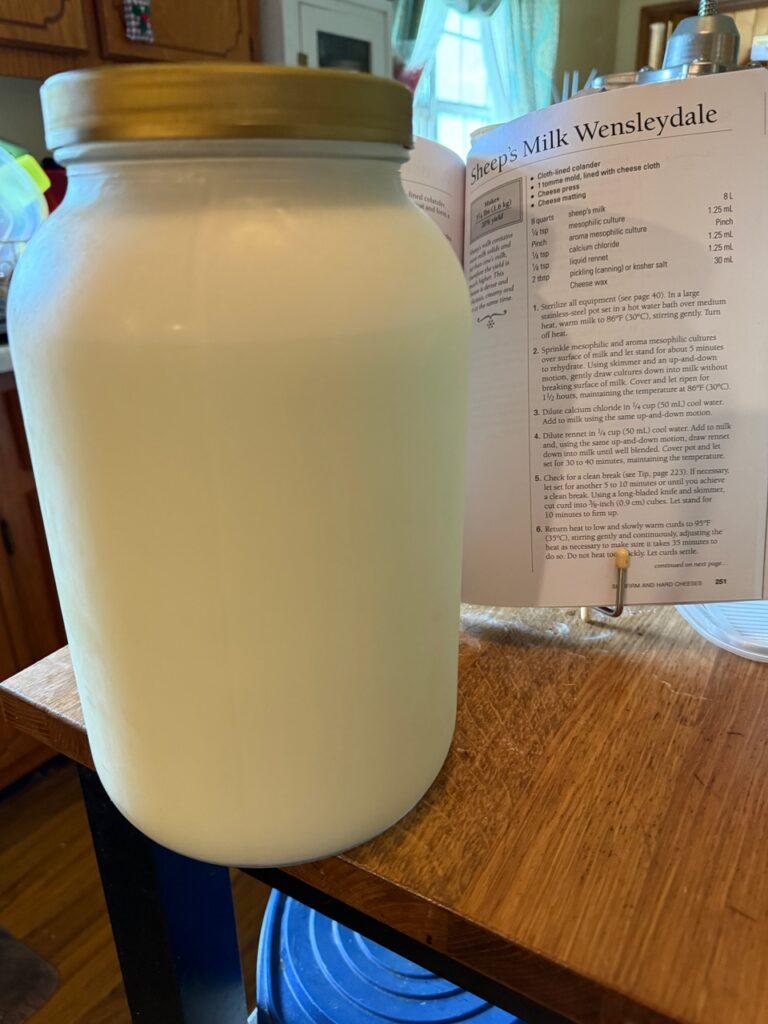
For the cow milk we need:
- 16 quarts of whole milk
- 1/2 tsp mesophilic culture
- 1/8 tsp aroma mesophilic culture
- 3/4 tsp rennet
- 3 Tbsp pickling salt
For the sheep’s milk we need:
- 16 quarts whole milk
- 1/2 tsp mesophilic culture
- 1/8 tsp aroma mesophilic culture
- 1/2 tsp rennet
- 3 Tbsp pickling salt
Here we can see tangibly that the sheep’s milk does not require as much rennet as the cow’s milk. The starter culture is the same amount, and actually sheep’s milk ferments slower than cow’s milk due to the lower lactose and higher fat content.
The first few steps are identical with the sheep and cow milk: Heat the milk to 86 degrees F or 30 degrees C. Sprinkle the cultures over the surface of the milk, let stand for about 5 minutes, gently use up-and-down motions with a slotted spoon to draw the cultures down into the milk, cover and let the cultures ripen the milk for an hour and a half, keeping the milk at 86 degrees F or 30 degrees C.
For both milks the rennet is diluted in 1/4 cup water – and remember we use less rennet for the sheep milk than the cow milk. It might take the sheep’s milk around ten minutes longer than the cow’s milk half hour of coagulation, but it may not.

If you decide to use lamb’s rennet, then your cheese will have a much stronger flavor than if you decide to use calf or other rennet. The sheep milk may also coagulate faster using lamb rennet than cow, but the coagulation time also depends on other factors with the milk.
Once you have a clean break, both curds are cut into 0.9 cm (or 3/8 of an inch) pieces, and left to stand for ten minutes to firm up. Both curds are then warmed very slowly back up to 35 C (or 95 F) while being stirred gently and continuously, over 35 minutes.
With the sheep’s milk you want to make sure that ‘gently stir the curds’ is emphasized. Sheep’s milk doesn’t want to be handled as roughly or dramatically as cow’s milk can tolerate. Once you have finished stirring and warming, let the curds settle to the bottom of the pot.
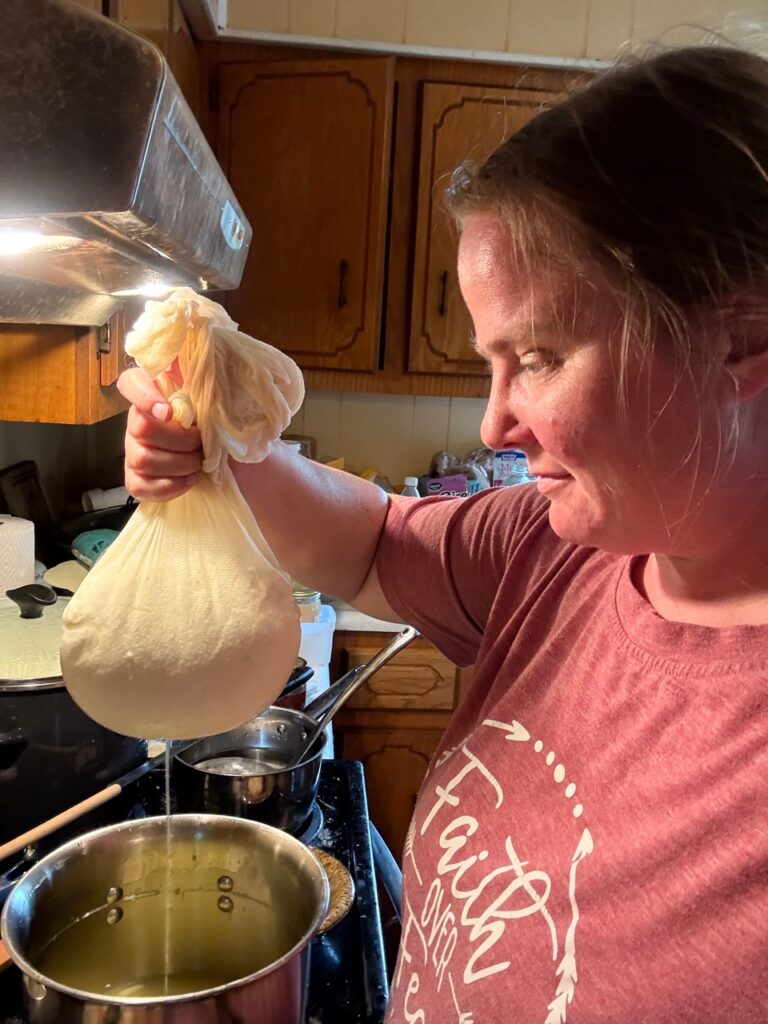
At this point both curds can be drained of their whey through a cloth lined colander, leaving the curds in the pot to mat into a cohesive spongy mass at the bottom of the pot. Here we come to the final difference: With the cow’s milk curds, you will cut the cord mass into four blocks, and will turn the blocks every ten minutes and pour off the whey that accumulates. With the sheep’s curds, you will simply let the mass of curds sit on the bottom of the pot for ten minutes, and then flip them once and let them sit for another ten minutes. The cow Wensleydale will have been flipped four times over forty minutes, whereas the sheep’s Wensleydale will have been flipped twice over twenty minutes. A subtle difference but importance for the final cheese’s texture.
Both curds are now cut into pieces of approximately 1.25 cm (or 1/2 inch) thick and 5 cm (or 2 inches) long. Place them in a bowl and toss with salt. Then pack the curds down into a prepared cheese mold, pressing the curds down firmly as you go. Press the curds under medium pressure for about thirty minutes, then flip and redress and press at a firm pressure for several hours or overnight. Remove the cheese from the press, unwrap, and let sit at room temperature for one or two days, turning a few times, until the rind is fairly dry to the touch.
Coat the cheese in a few layers of cheese wax and ripen at 10-12 celsius or 50-54 Fahrenheit turning weekly once or twice. Wait at least three weeks before eating, the longer you age the more flavor will develop.

Olivia Mills points out in her book that it is better to err on the side of caution when handling ewe’s milk while cheesemaking. Too much handling can lead to quite a bit of protein spilling. This can be redeemed by making traditional butter or ricotta cheese with it, but that does give us an extra step to worry with. On the other hand, one of my most favorite sheep cheeses ever is a ricotta salata cheese -or a dry mizithra. Simply make ricotta out of the spilled proteins and make a pressed cheese. Salt the rind and let it dry on the counter for a few days. If it stays soft it is a delightful alternative to Feta and I used to eat it in college on fresh bread from a local Bosnian bakery with rose hip jam. If you let it dry, it is phenomenal grated onto butter noodles with browned butter drizzled on top.
Another point Mrs. Mills gives us for consideration is that it is very easy to oversalt sheep milk cheese. Her recommendation is to dry salt the cheese rind or brine the cheese instead of mixing the salt into the curds. The Wensleydale recipe above blithely ignores this advice as you can see – the point being, once again err on the side of caution when using salt with your sheep milk cheeses.
Beginning dairy shepherds rarely dive head first into an alpine style cheese like a Wensleydale. In fact many dairy shepherds of my acquaintance stick with drinking the milk fresh, or at most making simple yogurts and ice creams with their milk – and struggle at maintaining enough supply for just those simple dishes without getting into cheesemaking!
Unlike goat milk, sheep cheese does not have quite the pungency one expects of smaller ruminant milk products. The flavors develop rather slowly, and are of more subtle natures than goat milk. Sheep cheese develops more warm, nutty, yogurt-y flavors as opposed to goat milk’s sharper pungent notes.
Altogether, sheep milk and cheeses are very much like the animals it comes from – they want to be handled gently and need less overt inputs like rennet or salt.
If I had to pick one word for shepherding and sheep cheese making, it would be ‘nuanced.’ There are so many subtle nuances with caring for sheep and encouraging their milk into cheese. While this is quite the dichotomy to our ‘hurry up and get it done’ world, the results beyond justify the efforts. Enjoying these delightful creatures in my daily life and feeling my body heal while eating their gourmet foods is one of the greatest joys of my life.