
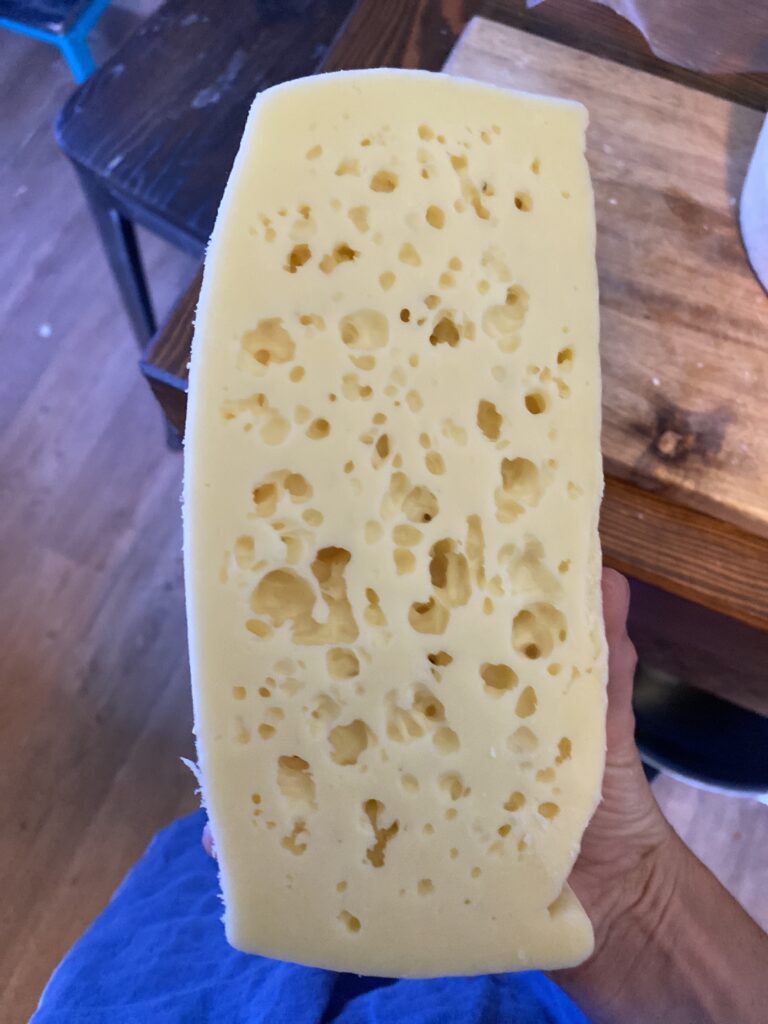
Oh I have asked myself this question so many times!
What are these holes?
I can not tell you how many times I have opened up a cheese to find it riddled with holes. They used to worry me a lot because I had such a hard time identifying them, and knowing why they were there. It took years of practice and mishaps to be able to identify what the holes in my cheese were.
Step 1; Identifying The Holes
Print out this PDF Troubleshooting flowsheet so that you can look back next time you are trying to figure out what is going on in your cheese.
Step 2; Diagnosing The Cause
Mechanical Holes
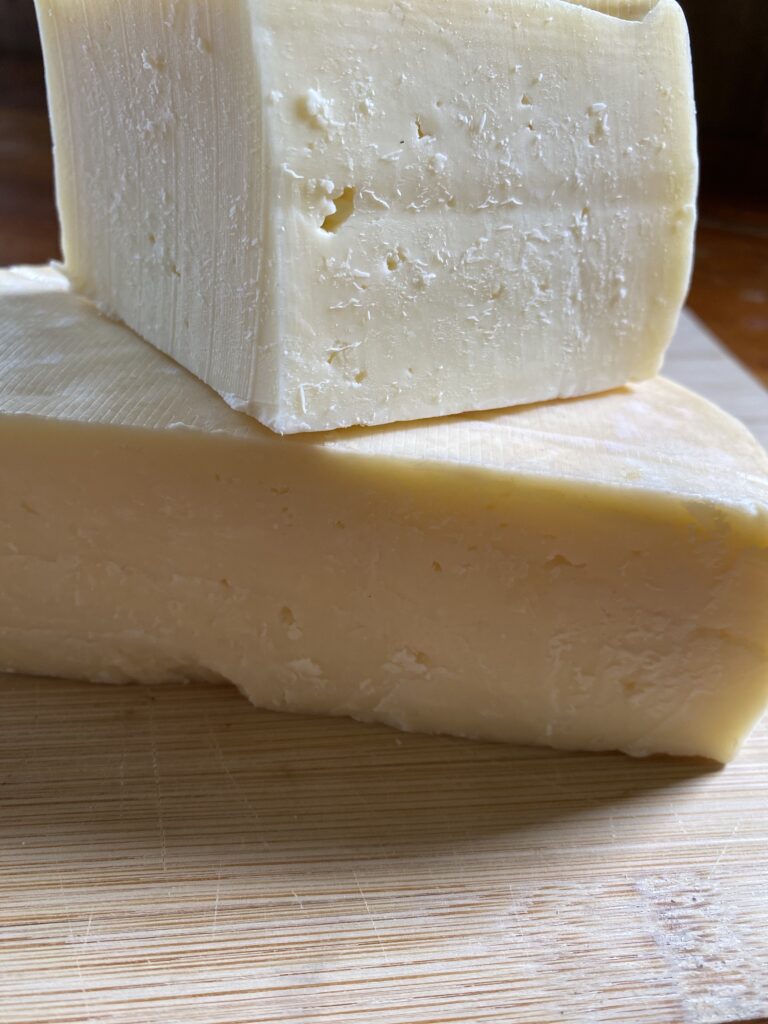
Mechanical holes are defects caused from the cheesemaking process or from pressing. Basically all they are, are pockets of moisture that have become trapped in the cheese and are unable to escape. The moisture eventually disperses or dissipates, but it leaves a fossil where it was before. Most often a cheese with mechanical holes is completely fine! Other than perhaps a more crumbly moist texture, a few mechanical holes are nothing to worry about.
If your cheese is riddled with mechanical holes, this may sometimes lead to a bitter taste. This is due to a high amount of moisture stuck in the cheese.
If you have a cheese that is riddled with mechanical holes, the best course of action is to work on your cheesemaking and pressing techniques. (See Preventing Mechanical Holes Troubleshooting Guide)
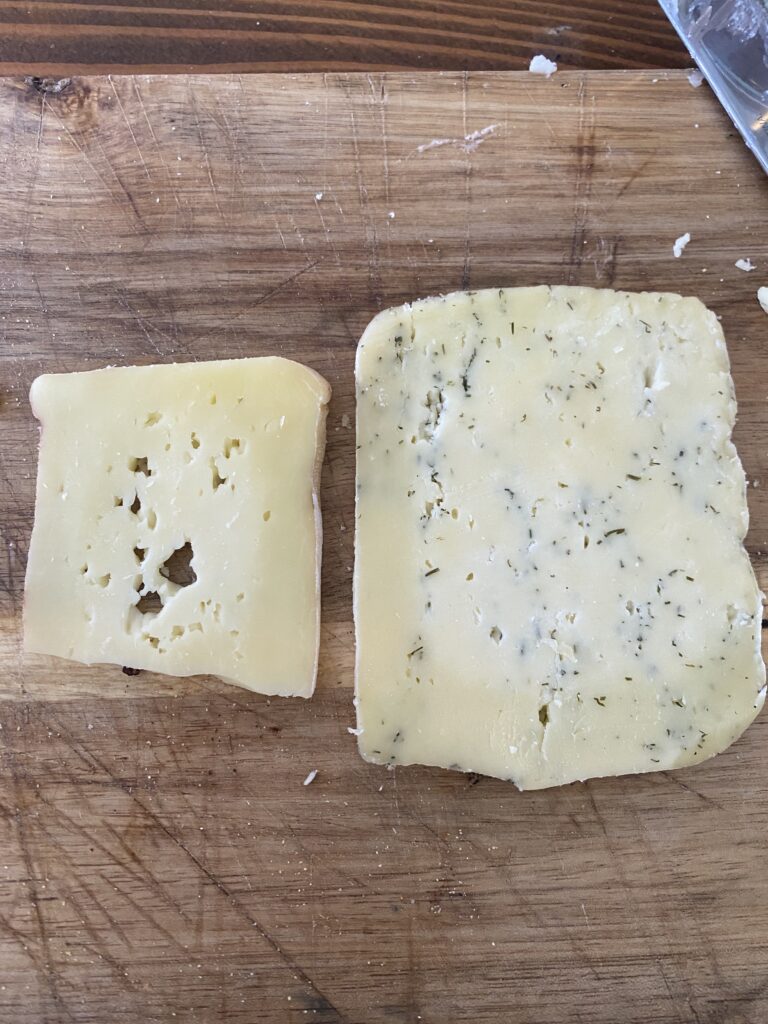
Gas Holes
Both bacteria and yeast can cause CO2 gas to be created during cheesemaking. However, not all bacteria are CO2 producing bacteria! Most of the standard lactic bacterias used as starter cultures for cheesemaking are not CO2 producing.
Unless planned for,(as in Swiss cheese), gas holes are indicative of a contamination. Sometimes this can be a dangerous contamination, other times it can be a safe, desirable contamination. This section looks at a few of the most common contaminations that cause holes. I have organized them into two categories; Early Blowing and Late Blowing.
Early Blowing (Contamination in the first few days after cheesemaking)
Early blowing is characterized by excessive gas formation in cheeses within the first day or two of making. It can be caused by either yeast contamination or bacterial contamination in cheeses. The contaminant feeds on nutrients in the cheese, the byproduct CO2 and H2, which form gas bubbles within the cheese. These gas bubbles pop, leaving behind shiny, usually perfectly round, holes. Gas holes can be distinguished from mechanical holes by not only their shiny interior and round shape, but also by their uniformity throughout the cheese.
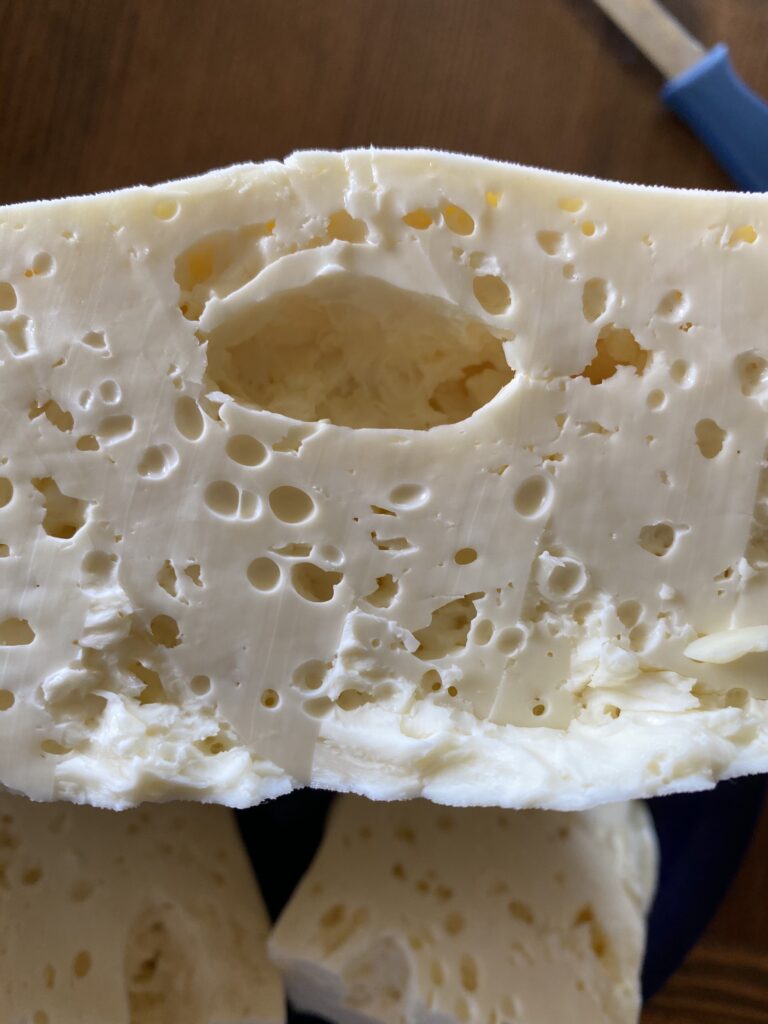
Yeast contamination is a common cause of early blowing. Raw milk naturally has yeast present in it, but yeast contamination can also come from cross contamination between ferments in your kitchen (like sourdough) or from other environmental sources. Yeast loves to feed on sugar and there is a lot of sugar in milk!
Most often you will notice a yeast contamination in your cheese within the first few days after making. I like to describe yeast contamination in cheese, as over proofed bread. Its like when you leave your bread dough a little too long and when you go to shape it, it is riddled with puffed up songs like holes! Thats what yeast contaminated cheese looks and smells like!
To limit yeast contamination risk during cheesemaking, it is recommended to not bake bread, to not keep a sourdough starter, to not keep ferments on the counter. As a homesteader, who has a lot of other things going on and needs to have these things taking up the same space as cheese, there are things we can do to prevent yeast contamination in our cheeses without giving up the sourdough!
First off, if you have a contamination and you suspect yeast, clean everything. Take a bucket of hot soapy water, with a tiny bit of bleach and go to town scrubbing all of your equipment, counters and surfaces. Toss out your salt brine (because yeast can live in there). Keep your ferments, and starters on one side of the kitchen and your cheesemaking supplies on the other. If you touch your ferments, wash your hands. By taking precautions to prevent cross contamination, you will have a lot lower risk of contaminating your cheese.
Yeast contamination smells yeasty; Think beer, or over proofed bread. I only ever eat a fresh contaminated cheese if it definitively smells yeasty. If it has puffed up but has no smell, I don’t eat it. Yeast contaminated cheeses are safe to consume but their close looking cousin Coliform is not, and it can be tricky to distinguish between the two. In fact you may find yourself not feeling comfortable eating your yeasty cheese! Thats ok! Cheese is not worth loosing sleep over, and if you are worried about if it is yeast or coliform, ease your worries by not eating it.
I don’t like to age yeast contaminated cheeses because they don’t often do well, but I will eat them fresh, stretch them into mozzarella, or shred them up and put them into things.
Coliform
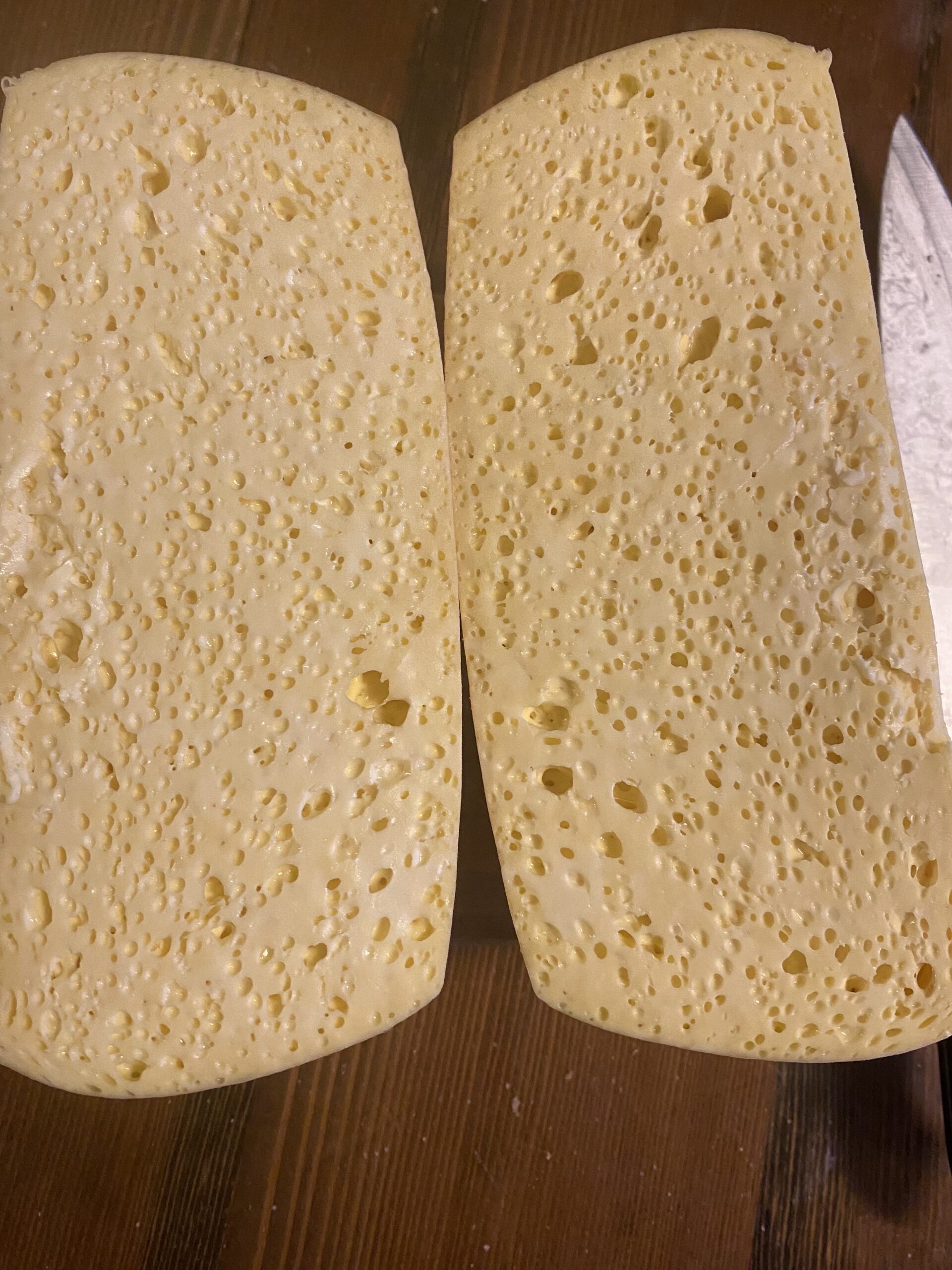
I have had a few instances of coliform contamination. They tend to not have a smell, and they really don’t have too much of a taste. Thats why if I have an early blowing contamination, I don’t eat it unless it smells or tastes yeasty. I have made myself sick with coliform before, and it doesn’t take a lot to make you sick!
When hunting for the cause of early blowing, the first thing you need to consider is your milk.
Raw milk will naturally have contaminants introduced into it during the milking process and during transport from the barn to the cheese pot. It is pretty safe to say that most raw milk probably has coliform bacteria in it. Coliform comes from cow poop, and is probably the most dreaded culprit of early blowing. The thing is…. Cow’s Poop. It’s life. The solution to prevent coliform contamination is to prevent a large amount of coliform getting into your milk and having an opportunity to multiply and thrive.
For example, did you milk out your milk and then forget it in the bucket for 2 hours before remembering to put it through the strainer? That milk just had a 2 hour time frame where it was cultured with coliform! By making sure you are using very good milk handling practices, you limit your chances of having a problem with coliform contamination.
When considering whether or not a case of early blowing is caused by coliform, ask yourself, “Did I use excellent Milk handling practices?”. If the answer is yes, then coliform is most likely not the culprit, but if it doesn’t smell like yeast, don’t eat it!
Late Blowing (A few weeks to a few months after making)
Late blowing is characterized by a swelling of your cheese during the aging process. It often affects hard pressed cheeses and can occur anywhere between a few weeks to months after beginning the aging stage. Traditional Swiss style cheeses, are actually meant to have late blowing. Late Blowing can be caused by several different types of bacteria that feed on lactose, lactic acid, or left over nutrients. This can produce many different byproducts, CO2 being one of them, which causes gas bubble formation.
Though there are a few different causes of Late blowing, it is usually caused by strains of either propionic acid bacteria, or clostridia bacteria.
Propionic Acid Bacteria
Propionic Acid Bacterias are the types of bacteria that are responsible for the eyes in Swiss style cheeses. By feeding on lactic acid they create not only a lovely buttery, nutty taste but also CO2 gas bubbles. As a cheesemaker you can buy certain strains of propionic acid bacteria to inoculate your cheese with, this helps ensure that you achieve the same results every time. However propionic bacterias are present in raw milk and can sometimes give you a surprise Swiss cheese!
If I age a cheese, I open it up and it has large eye formation inside it, as long as it tastes good and doesn’t smell like vomit, I eat it! You just accidentally made Swiss cheese! I have had this happen on both cheddars, and alpine style cheeses.
Clostridia
Clostridia bacteria (there are a few different strains, botulism is one of them that is more common in canned goods) is a harmful bacteria that can metabolize several different left over nutrients as cheese ages and breaks down. The main strain of clostridia that affects cheese produces butyric acid. Luckily, butyric acid smells bad! Think rotten eggs, vomit. Nobody wants to eat a vomit smelling cheese! Your nose is going to keep you safe on this one! It it smells like vomit, don’t eat it!
Conclusion
It is difficult to teach a lesson on contamination over a blog post. Nothing beats the real deal and every situation will be different. The main takeaway from this whole post should be that contamination happens, but that good cheesemaking and milk handling practices that limit contamination are always the best solution!
One Response